Best Submerged Arc Welding Machine Manufacturer in India: What to Look For
In the rapidly expanding industrial landscape, heavy fabrication demands precision, speed, and uncompromising structural integrity. Whether you are building massive pressure vessels, constructing heavy-duty railway girders, or shaping Pre-Engineered Buildings (PEBs), your equipment choice dictates your bottom line. Consequently, finding the right Submerged Arc Welding Machine Manufacturer is one of the most critical decisions your engineering team will make.
The Submerged Arc Welding (SAW) process relies on a granular flux blanket to shield the welding zone from atmospheric contamination. This method provides exceptionally deep penetration, minimal smoke, and clean, high-quality deposits. However, to unlock these advantages consistently, you need robust equipment backed by advanced technology. Selecting a reliable Submerged Arc Welding Machine Manufacturer in India goes far beyond looking at a simple price tag. It requires a deep dive into engineering standards, technological collaborations, and real-world application support. Let us break down exactly what you must look for when choosing your industrial fabrication partner.
Why Choosing the Right Manufacturer Impacts Production Quality
Heavy manufacturing leaves zero room for error. A single defect in a heavy-duty weld joint can delay timelines, skyrocket repair costs, or compromise structural safety. Therefore, your choice of heavy-duty welding equipment acts as the literal backbone of your workshop.
1. Advanced Technology Integration
The industrial sector has transitioned away from legacy systems. Today, standard workshops require high-efficiency setups that reduce manual intervention. When evaluating an industrial provider, look closely at their technical heritage. For instance, manufacturers utilizing specialized design partnerships, such as the globally recognized Panasonic technology framework, consistently deliver exceptional reliability. This advanced integration translates directly into stable arc performance, minimal downtime, and uniform bead profiles across miles of heavy steel fabrication.
2. Industry-Specific Customization
No two fabrication projects are exactly alike. A standard power source might suffice for simple structural steel, but complex pressure vessels require distinct wave-control configurations. A premier Submerged Arc Welding Machine Manufacturer should provide a wide array of specialized options, including:
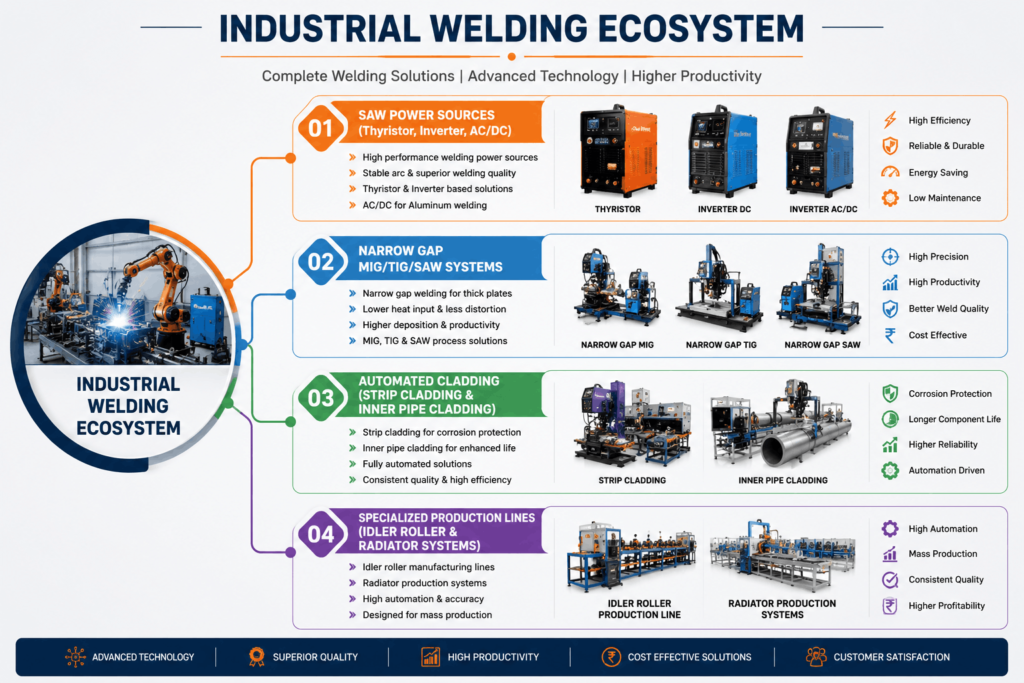
- Thyristor Based Power Sources: Ideal for rugged environments demanding extreme durability and high current outputs.
- Inverter Based Power Sources: Designed for maximum energy efficiency, precise digital control, and a compact workshop footprint.
- AC/DC Power Sources: The ultimate solution for multi-wire systems, preventing arc blow and maximizing deposition rates.
Core Criteria to Evaluate a Submerged Arc Welding Machine Manufacturer
When sorting through potential equipment suppliers in India, you must look past basic marketing claims. Use these technical and structural indicators to evaluate true engineering competence.
Engineering Footprint and Domestic Presence
Is the supplier a mere distributor, or do they possess a fully realized manufacturing setup? A true 100% Indian company with specialized roots can understand local power grid fluctuations, operating environments, and regulatory standards. For example, a dedicated facility located in a manufacturing hub like Pune, Maharashtra, serves as an ideal indicator of structural permanence.
Furthermore, a manufacturer with an active on-site demo center allows your technical teams to test advanced configurations before finalizing capital expenditures. Testing technologies like Narrow Gap SAW or advanced Strip Cladding Devices on your specific metal alloys removes all guesswork from the procurement loop.
Comprehensive Product Portfolio
A reputable heavy-duty welding equipment provider shouldn’t just sell power sources; they should deliver comprehensive automation workflows. If your operations grow, you will likely need to expand into adjacent automated systems. Choosing a partner who designs complementary technology ensures seamless long-term scaling. Ensure your chosen manufacturer offers a robust spectrum of industrial systems:
Technical Features Your Submerged Arc Welding Systems Must Have
Investing in heavy industrial machinery requires a checklist of non-negotiable technical features. If a manufacturer cannot offer these baseline capabilities, your production efficiency will inevitably lag.
1. Robust Duty Cycle and Thermal Rating
For continuous industrial fabrication, a 100% duty cycle at maximum current output is mandatory. Your machines must run effortlessly through long shifts without overheating or triggering thermal shutdowns. High-grade thyristor-controlled systems or digital inverter modules must be housed in dust-resistant, well-ventilated enclosures designed specifically for heavy-duty metal workshops.
2. Seamless Integration with Welding Automation Solutions
Manual SAW setups are increasingly rare. Modern factories rely on tractor units, welding booms, column-and-boom manipulators, and gantry systems. The power source you buy must feature flexible analog or digital communication interfaces to connect seamlessly with broader welding automation solutions. Without proper interface protocols, integrating the machine into a robotic cell or a heavy-duty automated girder line becomes an engineering nightmare.
3. Precision Wire Feeding Mechanisms
The quality of a submerged arc weld relies heavily on consistent wire delivery. Fluctuations in wire speed lead to variations in bead width and penetration depth. Look for heavy-duty, four-roll drive wire feeders that prevent slippage even when pulling thick wire diameters from massive wire spools over extended distances.
Maximizing Efficiency with Advanced Welding Processes
A visionary Submerged Arc Welding Machine Manufacturer does not stop at standard open-arc setups. They continually innovate, driving efficiency through specialized processes designed for high-stress manufacturing sectors.
Narrow Gap Submerged Arc Welding (SAW)
When welding exceptionally thick plates—such as those used in nuclear reactors, massive pressure vessels, or heavy defense infrastructure—traditional V-groove preparations require an immense volume of filler metal. This takes countless passes and consumes massive amounts of time and raw materials.
By upgrading to a specialized system like the Narrow Gap SAW, you can dramatically reduce the groove angle. This minimizes the total volume of weld metal required, slashes heating cycles, and drastically reduces overall fabrication time while maintaining immaculate radiographic quality.
Automated Strip Cladding
In the chemical, oil, and gas sectors, base metals must often be protected against corrosive substances. Instead of fabricating entire structures out of expensive corrosion-resistant alloys, engineers use a cost-effective alternative: overlaying a thick carbon steel plate with a protective layer using an automated Strip Cladding Device. A top-tier industrial manufacturer provides the precise power controls and specialized cladding heads required to deposit uniform, defect-free anti-corrosive linings efficiently.
Industrial Applications: Who Relies on Premium SAW Equipment?
To confirm that a manufacturer’s machinery can withstand your operational demands, look at the industries they actively serve. Heavy industrial environments require distinct performance characteristics that only specialized equipment can deliver.
- PEB & Infrastructure: Pre-Engineered Building manufacturers rely heavily on high-speed automated gantry lines running SAW machines to weld long H-beams and I-beams with minimal distortion.
- Pressure Vessels & Boilers: This sector demands flawless radiographic quality. Precision control over voltage and current parameters ensures deep penetration and clean slag detachment.
- Railway Girder Manufacturing: Heavy structural bridges and rail infrastructure demand extreme fatigue resistance. The uniform heating and controlled cooling of high-end SAW systems prevent localized brittleness.
- Shipbuilding & Marine Fabrication: Welding massive hull plates requires reliable, long-distance wire feeding and powerful traction carriages capable of operating continuously in humid, rugged shipyard environments.
Post-Purchase Support: The True Mark of a Top Manufacturer
The relationship with your Submerged Arc Welding Machine Manufacturer should never end when the equipment is delivered. In heavy manufacturing, every hour of unscheduled downtime translates directly into lost revenue. Therefore, long-term engineering support is just as critical as the initial build quality of the machine.
Technical Backup and Workforce Training
Transitioning to advanced automated systems or setting up a new AC/DC multi-wire SAW process introduces a learning curve for your shop floor operators. Your chosen provider must possess a proactive, highly technical backup team capable of executing on-site commissioning. Furthermore, they should provide comprehensive, hands-on training to qualify your welding operators, ensuring they can manage weld parameters, handle flux recovery units, and perform basic preventative maintenance with complete confidence.
Spare Parts Availability
Industrial machines operate in harsh, high-heat environments. Over time, contact tips, drive rolls, flux nozzles, and control cables will wear out. If your manufacturer relies entirely on imported, hard-to-source components, a simple part failure could halt your entire production line for weeks. Selecting a domestic supplier with a well-stocked inventory in India guarantees rapid turnaround times, keeping your production schedule firmly on track.
Partner with India’s Leader in Welding Automation
If you want to elevate your production output, minimize rework, and deploy world-class industrial technology, Kaiyuan Welding & Cutting Automation India Pvt Ltd is your definitive partner.
Established in 2015 in the manufacturing hub of Pune, Maharashtra, Kaiyuan India is a 100% Indian company backed by over 30 years of global group expertise in welding automation. By combining our proprietary engineering advancements with world-renowned Panasonic technology, we deliver Submerged Arc Welding systems that set the benchmark for industrial reliability.
Our advanced demo center in Pune allows you to see our cutting-edge machinery in action—ranging from heavy-duty Thyristor and Inverter SAW power sources to advanced Narrow Gap systems, strip cladding heads, and fully automated idler roller manufacturing lines. We don’t just supply machines; we provide comprehensive engineering backup, welder training, and an unyielding commitment to your operational success.
Ready to transform your heavy fabrication capabilities? Contact our expert engineering team today to discuss your project requirements, request a detailed technical consultation, or schedule a live demonstration at our Pune facility. Let us build an efficient, automated, and highly profitable future together.
Frequently Asked Questions (Q&A)
Q1: What makes Submerged Arc Welding (SAW) better than MIG or TIG for heavy fabrication?
SAW is uniquely optimized for heavy industries because it offers exceptionally high deposition rates and deep joint penetration. Because the arc is entirely submerged under a blanket of granular flux, there is virtually no visible arc flash, spatter, or toxic smoke. This allows operators to deposit large amounts of filler metal quickly and cleanly, making it far more efficient than MIG or TIG when welding thick plates.
Q2: Why is a 100% duty cycle important for an industrial SAW power source?
The duty cycle represents the percentage of a 10-minute period that a welding machine can safely operate at its maximum rated current without overheating. Heavy industrial environments require continuous, uninterrupted welding on long structural beams or large circumferential vessels. A 100% duty cycle ensures that the machine can run continuously through full shifts without requiring cooling breaks, thereby maximizing workshop productivity.
Q3: How does Narrow Gap SAW save on production costs?
Traditional deep-groove welding requires a wide V-groove preparation, which demands a massive volume of filler wire and flux to fill. Narrow Gap SAW utilizes specialized torch geometry and precise tracking systems to weld inside tightly narrowed joints. This significantly reduces the total amount of weld metal needed, reduces the number of welding passes, saves hours of fabrication time, and drastically lowers your raw material costs.
Q4: What is the difference between Thyristor-based and Inverter-based SAW machines?
Thyristor-based power sources are legendary for their ruggedness, simplicity, and extreme durability in harsh environments with highly unstable power grids. Inverter-based power sources, on the other hand, utilize modern semiconductor technology to offer significantly higher energy efficiency, compact space requirements, and precise digital control over the arc characteristics, resulting in highly refined bead aesthetics.
Q5: Can a Submerged Arc Welding machine be used for stainless steel cladding?
Yes, absolutely. By fitting a specialized strip cladding head to a high-capacity SAW power source, you can perform automated surface overlay welding. This process allows you to deposit a highly uniform layer of corrosion-resistant stainless steel or high-nickel alloy directly onto inexpensive carbon steel backing plates, providing excellent surface protection at a fraction of the cost of solid alloy plates.