
D TIG CLADDING MACHINE
Efficient D-TIG Welding Solution for Industrial Cladding Applications
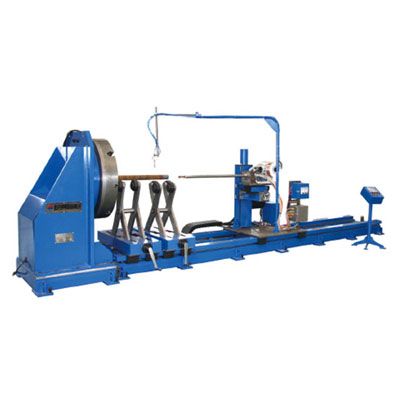
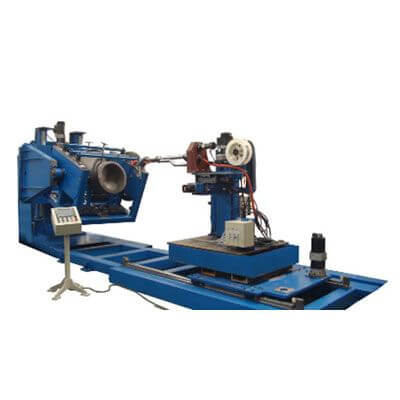
The D-TIG Cladding Machine is a high-precision system designed for depositing wear-resistant and corrosion-resistant layers using the Double-Tungsten Inert Gas (D-TIG) welding process. It is ideal for critical industrial components such as pipes, tubes, elbows, and pressure vessels where high-quality metallurgical bonding and uniform layer thickness are essential.
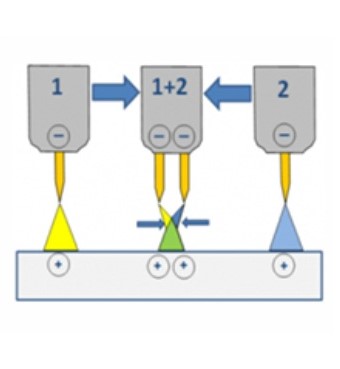
The D-TIG process allows for dual arcs to simultaneously deposit material, increasing deposition efficiency while maintaining low dilution and minimal heat input, which reduces distortion of the base material. This makes it suitable for chemical, petrochemical, power, and heavy machinery industries.
Key Features
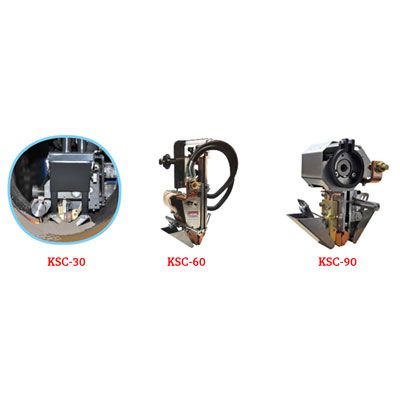
- Two tungsten in one torch, powered by one master power source and one slave PS to control the arc, so to reduce dilution rate and increase melt rate.
- Uses two tungsten electrodes to enhance deposition rate and provide uniform metallurgical bonding.
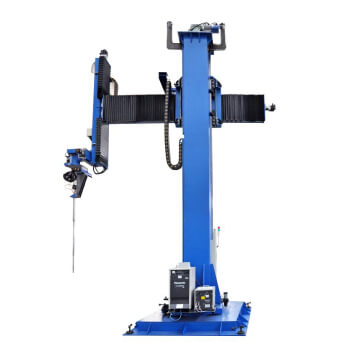
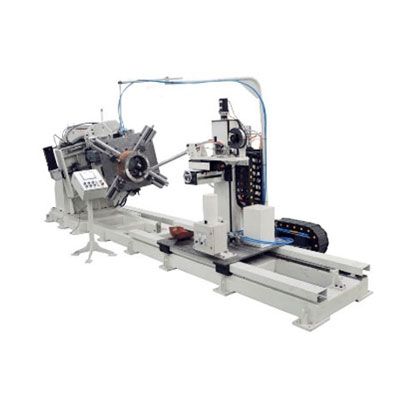
- Servo or hydraulic-controlled torch movement ensures precise cladding along internal or external surfaces.
- User-friendly interface for programming cladding parameters, monitoring, and adjustment in real-time.
Frequently Asked Questions
What you should know
What is D-TIG Cladding (DTC) technology?
D-TIG Cladding (Double Tungsten Inert Gas Cladding) is an advanced automated welding process that uses two tungsten electrodes to deposit corrosion-resistant and wear-resistant alloy layers on metal surfaces. It ensures high deposition efficiency, low dilution, and strong metallurgical bonding.
How is D-TIG Cladding different from traditional TIG welding?
Unlike conventional TIG welding, D-TIG uses dual tungsten arcs, which increases deposition rate and improves arc stability. It also reduces dilution and heat input, resulting in better surface quality and improved mechanical properties of the cladded layer.
What are the advantages of D-TIG Cladding machines?
D-TIG Cladding machines offer several benefits such as higher productivity, reduced dilution, uniform weld quality, better arc control, and minimal distortion. They are also suitable for automated operation, improving consistency and efficiency in industrial applications.
Which industries use D-TIG Cladding systems?
D-TIG Cladding systems are widely used in industries such as oil & gas, petrochemical, power generation, nuclear, and heavy engineering. They are ideal for components that require high corrosion resistance and long service life.
What materials can be used in D-TIG Cladding?
D-TIG Cladding can be used with various corrosion-resistant alloys including stainless steel, nickel-based alloys (like Inconel), and other hard-facing materials. These materials are selected based on application requirements and operating conditions.
Why is low dilution important in D-TIG Cladding?
Low dilution ensures that the base metal does not excessively mix with the cladding material. This helps maintain the chemical composition of the overlay layer, resulting in better corrosion resistance, improved wear performance, and longer component life.