
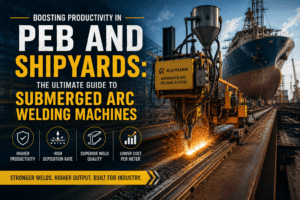
In the aggressive landscape of heavy industrial manufacturing, speed, structural integrity, and joint reliability dictate profit margins. Modern Pre-Engineered Building (PEB) plants and naval shipyards face relentless pressure to build taller, longer, and heavier structures while keeping labor costs and defect rates low. Meeting these stringent engineering standards requires transitioning away from manual open-arc practices. Integrating an advanced industrial arc welding machine built specifically for high-deposition continuous joining has become the standard for modern metal fabrication. When it comes to longitudinal beam joining and heavy plate seam synthesis, Boosting Productivity in PEB and Shipyards: The Ultimate Guide to Submerged Arc Welding Machines reveals why automated SAW technology stands as the ultimate catalyst for operational efficiency.
Whether your facility manufactures massive H-beams, box columns, bridge girders, or naval hull plates, your choice of machinery directly dictates daily throughput. This comprehensive guide explores the engineering mechanics, operational configurations, power source selections, and production strategies required to maximize output using high-performance submerged arc welding solutions.
1. Understanding the Submerged Arc Welding Process
To appreciate why a submerged arc welding machine outperforms standard manual metal arc (MMA) or flux-cored arc welding (FCAW) setups, one must examine its core physical mechanics.
In the submerged arc welding process, the electric arc is completely buried beneath a thick blanket of granular, fusible flux. As a continuously fed solid or cored electrode moves along the joint, the flux melts to form a conductive slag layer that protects the molten weld pool from atmospheric contamination.
Key Technical Characteristics of SAW Technology
- Complete Arc Concealment: Because the electric arc stays submerged, operators are not exposed to intense ultraviolet radiation, open flames, or hazardous spatter. Consequently, safety increases while protective gear requirements are streamlined.
- Deep Thermal Penetration: High current densities allow a heavy-duty SAW welding machine to penetrate deep into thick carbon steel plates, often eliminating or reducing expensive edge preparation grooves.
- High Deposition Rates: SAW systems deposit between 8 kg to over 25 kg of metal per hour depending on wire configuration, compared to 2–5 kg per hour for manual MIG or TIG systems.
- Zero Spatter & Minimal Fumes: The protective flux suppresses toxic fumes and traps molten droplets, yielding exceptionally clean weld beads with smooth contour transitions.
By replacing manual machine welding stations with an automated automatic welding system, fabricators eliminate operator fatigue variables and achieve flawless radiographic quality pass after pass. For authoritative research on flux-wire metallurgical interactions, refer to resources provided by the American Welding Society (AWS) and TWI Global.
2. Why PEB Fabrication Demands Automated Submerged Arc Welding
Pre-Engineered Building (PEB fabrication) relies on mass-producing tapered H-beams, I-beams, crane girders, and structural columns. A single PEB project may require thousands of meters of continuous fillet and groove welds. Performing these long, repetitive runs manually creates severe production bottlenecks, high filler metal waste, and inconsistent bead profiles.
Accelerating Web-to-Flange Joining
In PEB manufacturing, joining thin-to-medium web plates (4mm to 16mm) to thick flange plates demands consistent travel speeds to prevent burn-through or distortion. Utilizing specialized welding automation solutions like a double-head gantry welding machine enables simultaneous double-sided fillet welding.
- Simultaneous Dual-Sided Fillets: Welding both sides of a web-to-flange joint at once balances heat input, preventing asymmetric angular distortion across long member lengths.
- Precision Tracking Systems: Advanced seam trackers (tactile or optical) ensure the wire stays dead-center in the joint angle, even if structural plates exhibit slight waviness.
- High-Speed Travel Carriages: Mechanized tractor and gantry units move smoothly along linear guide rails at constant speeds, producing uniform weld legs without humping or undercut.
Furthermore, integrating a high-capacity welding power source allows continuous duty-cycle operation across multi-shift production schedules. To explore industrial-grade gantry and tractor configurations engineered for structural steel, review the specialized solutions at Kaiyuan India.
3. Revolutionizing Shipyard Operations: Heavy Plate Joining with SAW
Shipbuilding involves joining massive carbon steel and low-alloy plates to construct hull sections, deck modules, bulkheads, and stiffeners. Unlike light industrial manufacturing, shipyard environments present extreme plate thicknesses (25mm to 100mm+), tough working conditions, and mandatory classification society inspections (e.g., DNV, ABS, LRS).
Overcoming Shipyard Manufacturing Friction
- Thick Plate Butt Joints: Joining hull plates requires heavy heat input and complete joint fusion. Heavy-duty submerged arc systems perform full-penetration butt welds with minimal pass counts, drastically reducing bevel preparation time.
- Resilience in Rugged Conditions: Shipyard tractors and tractor-mounted feeding heads must endure dust, moisture, and temperature fluctuations. Robust mechanical drive assemblies prevent wire slippage when pulling heavy wire spools across long deck spans.
- Radiographic Joint Integrity: Maritime vessels encounter continuous cyclic loads and corrosion. SAW’s low-hydrogen slag blanket ensures ultra-clean weld metal deposits that pass stringent ultrasonic and radiographic non-destructive testing (NDT).
By deploying heavy structural welding systems designed for extreme environments, shipyards reduce shipway occupancy times and accelerate vessel delivery schedules.
4. Key Equipment Specifications: Power Sources & Automation Hardware
Selecting the right power source and motion system is essential when designing a heavy industrial welding station. Modern industrial plants choose between legacy transformer-thyristor power supplies and advanced inverter-based systems.
Inverter vs. Thyristor Power Sources
| Specification Feature | Legacy Thyristor Power Source | Modern Inverter AC/DC Source | Industrial Advantage |
| Energy Efficiency | 65% – 75% | 88% – 95% | Up to 30% lower electrical power consumption |
| Arc Stability | Moderate response time | Real-time microsecond control | Superior arc starting, minimal stubbing |
| Current Output Type | DC Only or Fixed AC | Switchable / Variable AC & DC | Full flexibility across multi-wire setups |
| Footprint & Weight | Large, heavy transformer unit | Compact, modular housing | Maximizes floor space on gantry beams |
| Duty Cycle Rating | 100% at rated output | 100% at rated output | Continuous multi-shift manufacturing |
A heavy duty inverter AC DC power source gives fabricators the flexibility to run DC positive polarity for maximum root penetration, and switch to square-wave AC polarity for rapid fill passes. AC polarity effectively eliminates magnetic arc blow—a common nuisance in heavy plate corner joints and narrow grooves.
Detailed technical guidance on choosing power sources for continuous manufacturing is available in Kaiyuan’s Submerged Arc Welding Machine Manufacturer Guide.
5. Advanced SAW Configurations: Tandem, Narrow Gap, and Gantry Systems
Standard single-wire SAW offers high productivity, but high-volume PEB plants and shipyards often require multi-wire, mechanized configurations to unlock maximum throughput.
1. Tandem Submerged Arc Welding
Tandem submerged arc welding utilizes two separate wire feeds positioned sequentially in the same weld puddle.
- Lead Electrode (DC+): Operates on direct current to dig deep into the root of the joint, establishing complete fusion.
- Trail Electrode (AC): Operates on alternating current to lay down large volumes of filler metal without pulling the lead arc.
Consequently, tandem setups double or triple line speeds compared to single-wire systems, making them ideal for long PEB beam runs and shipyard panel lines.
2. Narrow Gap SAW Technology
When plate thickness exceeds 40mm, traditional open-bevel preparation requires massive amounts of weld metal. Narrow Gap SAW reduces the included joint angle down to 2–5 degrees.
- Metal Volume Reduction: Cuts filler metal requirement by up to 60% compared to standard V-grooves.
- Heat Input Control: Reduces total heat input, minimizing heat-affected zone (HAZ) embrittlement and angular distortion.
- Slag Detachment: Specialized flux formulations and torch head nozzles ensure effortless slag removal from tight parallel walls.
3. Customized Gantry and Manipulator Systems
To automate complex structural assemblies, SAW heads are integrated into gantry frames, column-and-boom manipulators, or specialized tractor units. These motion platforms synchronize wire feed speed, carriage movement, voltage adjustments, and flux recovery units into a unified control interface.
6. Standard Submerged Arc Welding vs. Open-Arc Methods
To evaluate the return on investment (ROI) of upgrading to automated SAW systems, consider how key process metrics compare across common heavy structural processes:
| Process Parameter | Shielded Metal Arc (SMAW / Stick) | Flux-Cored Arc (FCAW) | Submerged Arc Welding (SAW) |
| Automation Level | Manual | Semi-Automated / Manual | Fully Automated |
| Operating Factor (Arc-On Time) | 20% – 30% | 40% – 50% | 70% – 90% |
| Deposition Rate | 1.5 – 3.0 kg/hr | 3.0 – 6.5 kg/hr | 8.0 – 25.0+ kg/hr |
| Radiographic Defect Rate | Moderate to High | Low to Moderate | Near-Zero (<0.5%) |
| Operator Skill Requirement | Very High | High | Operator / Technician Level |
| Post-Weld Cleaning | Heavy Slag & Spatter Removal | Slag Removal & Spatter Scraping | Simple Slag Peeling (No Spatter) |
As shown above, automated SAW increases arc-on efficiency by up to three times while delivering higher deposition rates. Fabricators recoup their capital investment through savings on labor, shielding gas cylinders, grinding consumables, and defect rework.
7. Overcoming Common Operational Challenges in Heavy Structural Welding
While SAW provides unmatched efficiency, achieving consistent results requires managing key operational variables.
1. Flux Management and Moisture Control
Granular flux is hygroscopic; it absorbs atmospheric moisture if left exposed. Damp flux introduces hydrogen into the weld pool, causing cold cracking or surface porosity.
- Pre-Heating & Storage: Store flux in climate-controlled hoppers and bake according to consumable manufacturer recommendations.
- Closed-Loop Vacuum Recovery: Modern SAW machines feature integrated vacuum recovery units that extract un-melted flux, screen out fine particles, and return reconditioned flux back to the hopper automatically.
2. Preventing Joint Drift
On 15-meter PEB beams or shipyard plates, subtle thermal expansion can cause the weld seam to drift away from the wire head. Utilizing automated tactile or optical laser tracking heads ensures the electrode stays positioned in the root, maintaining fusion across the entire length.
8. Kaiyuan India: Driving Growth with Advanced Welding Automation
Implementing industrial automation requires more than buying standalone machinery—it demands a strategic partner capable of designing, integrating, and supporting customized production lines.
Established in 2015 in Pune, Maharashtra, Kaiyuan Welding & Cutting Automation India Pvt. Ltd. combines global engineering innovation with localized technical support. Powered by proprietary design advancements and world-class Panasonic technology integrations, Kaiyuan delivers heavy-duty welding equipment engineered for demanding operational cycles.
Whether you need a flexible tractor SAW unit for field fabrication or a fully automated gantry system for high-volume structural production, Kaiyuan provides tailor-made solutions tested against strict international quality benchmarks. Visit the official Kaiyuan About Us Page to learn more about our manufacturing background and Pune demo facility.
9. Elevate Your Production Output: Schedule a Live Demo
Are structural bottlenecks, rising labor costs, or weld quality rejections slowing your workshop down? Upgrading your facility with high-performance submerged arc welding technology can transform your operational efficiency.
Partner with Kaiyuan India to upgrade your fabrication capabilities. Experience our high-speed SAW machines, inverter power sources, and gantry automation setups in person at our live Pune demonstration facility. Our engineering team will analyze your project blueprints, conduct weld trials on your test samples, and recommend the ideal automation configuration for your budget.
- Call Our Automation Experts: +91 89566 13642
- Email Us: info@kaiyuan.in
- Explore Our Complete Product Portfolio: Kaiyuan Official Website
10. Frequently Asked Questions (Q&A)
Q1: What makes a submerged arc welding machine more productive than FCAW or MIG welding in PEB manufacturing?
A submerged arc welding machine delivers higher deposition rates (8 to 25+ kg/hr) and operates at higher duty cycles (up to 100%) compared to manual or semi-automatic FCAW/MIG setups. Because the arc is buried under flux, high currents (600A–1200A+) can be used without spatter or intense arc flash, enabling faster travel speeds and deeper single-pass penetration on long PEB web-to-flange joints.
Q2: What is the benefit of using an AC/DC inverter power source for SAW?
Inverter-based AC/DC power sources offer precise digital control over the output wave shape. Using DC polarity provides maximum root penetration for initial passes, while switching to AC polarity prevents magnetic arc blow and maximizes deposition rates during fill passes. Additionally, inverter systems consume up to 30% less electrical power than older transformer-thyristor units.
Q3: Can submerged arc welding be used for out-of-position welding in shipyards?
No, standard submerged arc welding relies on gravity to hold the granular flux blanket over the weld pool, making it suited primarily for flat (1G/1F) and horizontal fillet (2F) positions. In shipyards, large panel lines, deck plates, and stiffener assemblies are designed to be welded in the flat position using mechanized tractors or gantries to take advantage of SAW’s high deposition rates.
Q4: How does tandem SAW increase welding speed?
Tandem SAW uses two electrodes feeding into the same weld pool simultaneously. The leading DC electrode provides deep penetration into the joint root, while the trailing AC electrode deposits a large volume of filler metal to fill the groove. This dual-action mechanism allows travel speeds to be doubled or tripled without risking lack-of-fusion defects.
Q5: Why is flux recovery important in automated SAW systems?
Flux recovery units automatically vacuum un-melted granular flux back into the hopper during welding. This reduces raw material waste, keeps the work surface clean, and prevents atmospheric moisture contamination that could cause hydrogen cracking or porosity in critical structural joints.