
Plant operations heads in heavy engineering face relentless pressure. Project schedules shrink while weld tolerances grow tighter. Manual pipe marking, template tracing, and hand-guided torch cuts slow down shop-floor throughput. A 7-Axis NC Pipe Cutting Machine solves these bottlenecks by turning complex tubular geometry into repeatable, high-speed CNC execution.
In modern structural steel fabrication, tubular members carry heavy axial and torsional loads across trusses, space frames, offshore jackets, and industrial plants. Every saddle, coped end, or angled joint must fit cleanly before arc welding starts. When fit-up drifts out of tolerance, fitters spend hours grinding gaps, forcing weld metal to bridge wide clearances. That rework inflates labor hours, consumes excess filler wire, and risks distortion.
By adopting a 7-Axis NC Pipe Cutting Machine, fabrication plants move from craft-dependent manual labor to predictable industrial automation. Multi-axis motion lets the cutting head maintain optimal torch standoff and angle across curved surfaces. As a result, shops cut cycle times, slash scrap rates, and keep downstream welding stations running at full capacity.
Why Manual Pipe Cutting Creates Bottlenecks in Structural Steel Fabrication
Walk through almost any conventional pipe fabrication bay and you will spot the same slowdown. Fitters measure lengths with tapes, wrap paper templates around round or square tubes, and chalk cut lines by hand. Next, an operator guides a handheld torch around the circumference.
That workflow introduces error at every step. Curvature distorts paper templates. Operator fatigue changes torch travel speed. Heat input varies as the torch angle shifts around the pipe wall.
The Hidden Cost of Fit-Up Gaps and Rework
Poor cut geometry shows up immediately at the tack-up table. A gap that is too wide forces welders to make multiple passes just to fill space. A gap that is too tight requires grinding back the root before welding can begin.
According to structural steel industry guidance from the American Institute of Steel Construction, dimensional accuracy and clean joint preparation are vital for structural integrity and predictable fabrication economics. When joints are poorly prepared, crane time increases, fixture occupancy stretches out, and daily tonnage per bay drops.
Labor Bottlenecks and Skilled Workforce Shortages
Experienced pipe fitters and skilled thermal cutters take years to train. Relying on scarce manual specialists creates single-point failure risks on tight delivery schedules. When a key operator takes leave or a rush order arrives, output stalls.
Automated pipe cutting equipment shifts skill from manual torch manipulation to CAD/CAM programming and machine tending. One trained operator can oversee part loading, program selection, and cut quality checks across high-mix batches.
How a 7-Axis NC Pipe Cutting Machine Transforms Shop-Floor Throughput
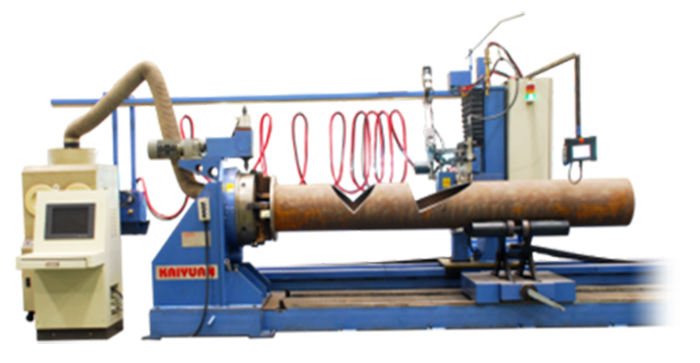
A 7-Axis NC Pipe Cutting Machine coordinates multiple linear and rotary axes simultaneously under numerical control. Instead of forcing the pipe or torch through awkward manual repositioning, the controller calculates exact toolpaths across complex 3D profiles.
Multi-axis articulation keeps the cutting head oriented properly relative to the pipe surface. Even where pipe wall curvature changes rapidly, the system maintains consistent geometry. That control is essential for clean bevel cutting accuracy along non-planar joints.
Precision Intersection Line Cutting Without Manual Templates
Structural trusses, T-joints, Y-joints, and K-joints require exact intersection line cutting where branch pipes meet main chords or headers. Calculating and scribing those saddle curves by hand is slow and error-prone.
With numerical control, complex saddle profiles execute automatically from digital geometry. Branch ends seat tightly against the mating surface, cutting tack-up alignment time and reducing root-opening variation.
Seamless CAD/CAM Integration from Drawing to Cut
Modern structural engineering teams design assemblies in 3D CAD and detail connection geometry digitally. CAD/CAM integration bridges engineering drawings and shop-floor cutting without manual re-drafting.
Engineers or programmers export joint parameters or part geometry into CAM nesting and toolpath software. The controller generates smooth motion paths, optimizes lead-ins and lead-outs, and nests parts to maximize stock utilization.
Consistent Bevel Cutting Accuracy for Structural Welds
Full-penetration and partial-joint-penetration tubular welds often demand specific bevel angles, root faces, and land dimensions. Consistent bevel cutting accuracy prepares a uniform groove around the entire perimeter of the pipe.
Technical standards such as the AWS D1.1 Structural Welding Code emphasize proper joint fit-up, root opening control, and groove geometry for sound structural welds. Accurate bevels help welders achieve consistent fusion while minimizing burn-through and excessive weld buildup.
Core Capabilities of a 7-Axis NC Pipe Cutting Machine
Choosing the right cutting platform starts with matching machine kinematics to your material mix. A 7-Axis NC Pipe Cutting Machine handles demanding profiles that single-axis saws or basic rotary cutters cannot finish in one setup.
| Fabrication Requirement | Manual / Basic Cutting | 7-Axis NC Pipe Cutting Machine | Operational Impact |
| Complex saddles & coping | Manual templates & grinding | Automated intersection line cutting | Faster fit-up and fewer tack adjustments |
| Angled structural cuts | Repeated clamping & marking | Smooth mitre cutting under NC control | Higher throughput on truss & frame members |
| Groove preparation | Inconsistent hand-torch angles | Repeatable bevel cutting accuracy | Cleaner weld prep and less filler waste |
| Drawing-to-cut handoff | Manual dimension entry | Direct CAD/CAM integration | Fewer transcription errors and faster setup |
| Material & wall range | Limited by operator skill | Flexible plasma/oxy-fuel cutting | Handles thin-to-heavy structural sections |
Mastering Mitre Cutting and Complex End Profiles
Structural steel frames rarely use square cuts alone. Diagonal braces, portal rafters, and purlin connections frequently demand angled mitre cutting, slot cuts, holes, and compound end trims.
A 7-Axis NC Pipe Cutting Machine executes these multi-plane cuts in a continuous cycle. Operators avoid unbolting, rotating, and re-clamping heavy pipes multiple times between operations.
Optimizing Plasma/Oxy-Fuel Cutting Across Wall Thicknesses
Different structural jobs call for different thermal cutting strengths. Plasma/oxy-fuel cutting configurations let fabrication plants match process speed and edge capability to wall thickness and steel grade.
Plasma cutting excels on thinner-to-medium walls where high travel speeds boost productivity and cut clean profiles. Oxy-fuel cutting remains a proven workhorse for heavy carbon steel walls where thick-section thermal capacity is required.
Pairing a 7-Axis NC Pipe Cutting Machine with Saddle and Bevelling Systems
No single machine covers every pipe fabrication scenario on its own. High-performing plants pair a 7-Axis NC Pipe Cutting Machine with dedicated automated pipe cutting equipment tailored to specific workflows.
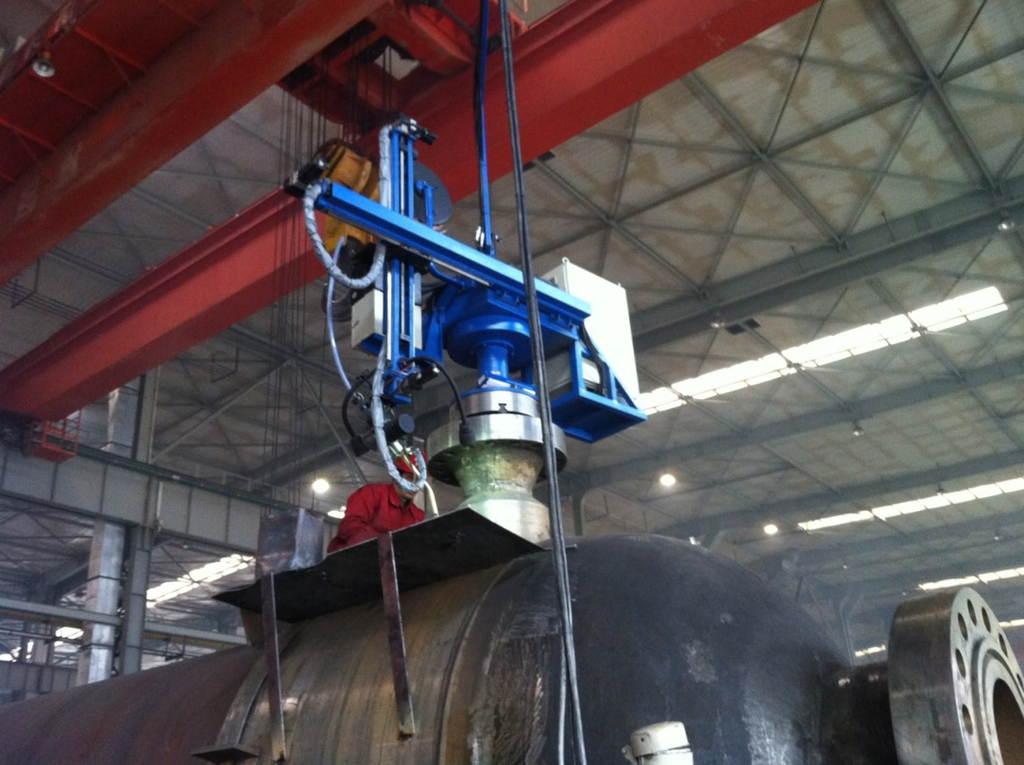
For dedicated branch preparation and tubular joint welding, a specialized saddle cutter and welder streamlines nozzle and branch connections. You can explore how dedicated branch profiling works on Kaiyuan’s 4-Axis NC Saddle Cutter page.
When to Use a Dedicated Saddle Cutter and Welder
When a fabrication line processes high volumes of pipe-to-pipe saddles, header branch connections, or repetitive nozzle joints, a saddle cutter and welder setup keeps cycle times tight. Pairing accurate saddle cutting with controlled joint welding reduces bottlenecks between fit-up and final weld completion.
In multi-machine workshops, a 7-Axis NC Pipe Cutting Machine can handle intricate multi-axis structural profiles and complex end cuts. Meanwhile, dedicated saddle and bevelling units absorb high-volume repetitive runs.
High-Speed Pipe End Prep with Automatic Cutting and Bevelling
Straight cut-off lengths and uniform pipe end bevels are foundational in piping spools, structural columns, and heavy tubular assemblies. Dedicated automated pipe cutting equipment built for continuous end-prep speeds up raw material processing.
Reviewing options like Kaiyuan’s Automatic Cutting and Bevelling Machine shows how automated clamping, feeding, and bevelling cut handling delays. Together with a 7-Axis NC Pipe Cutting Machine, these systems balance high-mix complexity with steady batch output.
Key Selection Criteria for Plant Operations Heads
Investing in CNC pipe profile cutting requires looking past brochure specs. Operations leaders should evaluate how the machine fits into existing crane bays, material flow, and quality standards.
1. Pipe Diameters, Lengths, and Structural Sections
List the outer diameters, wall thicknesses, and stick lengths your plant fabricates most often. Check whether your workload focuses on round pipe, rectangular hollow sections, or square tubing.
Verify chucking and roller support capacities so long, heavy pipes do not sag during rotation. Proper support prevents ovality and keeps cutting tolerances steady from end to end.
2. Thermal Source Selection and Consumable Economics
Evaluate plasma/oxy-fuel cutting options based on your steel grades and typical thickness range. Look at pierce times, cut speeds, bevel capability, and consumable replacement intervals.
Lower consumable wear and fewer aborted cuts translate directly into lower cost per meter cut. Factor in gas supply stability, power quality, and fume extraction requirements inside your bay.
3. Software Usability and Operator Training
Even the best 7-Axis NC Pipe Cutting Machine underperforms if programming takes too long. Check how easily your team imports models, sets cut sequences, and simulates paths before cutting steel.
Look for intuitive HMI controls so operators can adjust parameters safely without deep coding expertise. Fast program changeovers keep small-lot custom orders profitable.
4. Serviceability, Spares, and Local Technical Support
Downtime on a primary cutting cell ripples through fitting, welding, painting, and dispatch. Ask vendors about spare parts availability, diagnostic support, and response times in your region.
You can browse the broader lineup of Kaiyuan Welding and Cutting Automation Products to see how cutting and welding systems fit together in industrial plants.
Practical Implementation Roadmap for Fabrication Plants
Rolling out a 7-Axis NC Pipe Cutting Machine works best as a structured shop-floor project rather than a last-minute installation. A clear plan aligns engineering, production, and maintenance before the machine arrives.
Step 1: Audit Current Cutting Bottlenecks and Scrap
Track current cutting hours, manual grinding hours, and pipe scrap rates over several weeks. Identify the top joints and part families that cause fit-up delays or missed delivery dates.
This baseline gives plant leadership clear metrics to measure cycle-time reduction after commissioning.
Step 2: Prepare Foundation, Power, and Material Handling
Confirm floor load capacity, leveling requirements, electrical supply, compressed air, and cutting gas lines early. Plan raw-material staging racks and finished-part outfeed lanes so forklift or crane traffic never blocks the machine.
Smooth material flow prevents the cutting head from waiting on loading and unloading.
Step 3: Standardize CAD/CAM Workflows and Operator SOPs
Set naming conventions, material libraries, and cut-quality check sheets before production starts. Train both programmers and machine operators on safe clamping, torch setup, and routine maintenance.
Clear standard operating procedures help every shift run the 7-Axis NC Pipe Cutting Machine consistently.
Why Partner with Kaiyuan India for Pipe Cutting and Welding Automation
For operations heads in India, local engineering support and proven application know-how make a major difference. Kaiyuan Welding & Cutting Automation India Pvt. Ltd. (KWAI) builds industrial welding and cutting automation solutions backed by ISO 9001:2015 quality systems.
Operating out of Pune, Maharashtra, Kaiyuan India supports fabricators with practical process guidance, application testing, and hands-on workforce training. Plant teams can evaluate equipment capabilities, review joint preparation workflows, and get technical backup tailored to real shop-floor demands.
Whether you are upgrading CNC pipe profile cutting, integrating a 7-Axis NC Pipe Cutting Machine, or pairing a saddle cutter and welder with automated welding lines, having a responsive automation partner protects your schedule.
Ready to Eliminate Pipe Cutting Bottlenecks in Your Plant?
Stop losing valuable fabrication hours to manual templates, uneven bevels, and slow fit-up rework. Connect with the automation specialists at Kaiyuan India to discuss your pipe sizes, joint profiles, and production targets. Visit Kaiyuan India to request a technical consultation, schedule a live equipment discussion, or get a tailored quote for your facility.
Frequently Asked Questions About 7-Axis NC Pipe Cutting Machines
What does a 7-Axis NC Pipe Cutting Machine do in structural fabrication?
A 7-Axis NC Pipe Cutting Machine automates multi-axis cutting of pipes and tubular profiles for structural steelwork. It helps fabricators produce accurate saddles, mitres, slots, and bevels with high repeatability and less manual rework.
How does CNC pipe profile cutting improve fit-up before welding?
CNC pipe profile cutting follows programmed toolpaths rather than hand-traced templates. That precision creates tighter joint alignment between branch and main members, reducing gap filling and grinding time before welding begins.
Can a 7-Axis NC Pipe Cutting Machine handle both bevels and intersection cuts?
Yes. Multi-axis control allows the cutting head to adjust orientation along complex curves and angled ends. This capability supports intersection line cutting, mitre cutting, and controlled bevel cutting accuracy in integrated cycles.
Should we choose plasma or oxy-fuel cutting on a pipe cutting machine?
The right choice depends on material thickness, steel type, and speed targets. Plasma/oxy-fuel cutting options let plants use plasma for faster cuts on suitable thicknesses and oxy-fuel for heavy carbon steel sections.
How does CAD/CAM integration help plant operations heads?
CAD/CAM integration converts engineering geometry directly into machine toolpaths and nesting layouts. It reduces manual re-measurement, speeds up job changeovers, and helps planners predict material usage and cycle times accurately.
When should a shop add a saddle cutter and welder alongside a pipe cutting machine?
Adding a saddle cutter and welder makes sense when your plant handles dedicated pipe branch joints, nozzles, or repetitive tubular connections. Pairing specialized equipment with a 7-Axis NC Pipe Cutting Machine boosts overall throughput across varied orders.