
How to Choose the Right Industrial Welding Machine: A Complete Buyer’s Guide
Selecting the proper equipment for heavy manufacturing operations is a decision that dictates long-term profitability, product quality, and operational safety. In the modern fabrication landscape, making an accurate industrial welding machine selection requires balancing multiple complex variables. A wrong equipment purchase can easily lead to structural joint failures, unexpected production bottlenecks, and costly operational downtime. Conversely, aligning your choice with your exact material specifications and volume targets can dramatically boost throughput and cut scrap rates.
This comprehensive guide breaks down the essential factors needed to execute a flawless industrial welding machine selection. From decoding technical specifications to determining the right level of automation for your floor, we will outline the blueprint for a smart procurement strategy. Whether you are looking to upgrade a single station or fully overhaul an automated production assembly line, this resource is designed to help you make an informed decision.
1. Core Heavy-Duty Welding Processes and Equipment Types
The foundation of sound industrial welding machine selection begins with identifying the most suitable welding methodology for your application. Each major process offers distinctive performance characteristics tailored to specific material types and structural demands.
Submerged Arc Welding (SAW) Power Sources
For thick structural steel fabrication, pressure vessels, and heavy infrastructure projects, Submerged Arc Welding remains the undisputed standard. SAW systems utilize a granular flux layer to blanket the molten weld pool, completely eliminating arc flash and hazardous smoke while delivering exceptionally deep penetration.
- Thyristor-Based vs. Inverter-Based Power Sources: Traditional thyristor systems are renowned for their rugged dependability in harsh foundry conditions. However, modern inverter-based SAW units provide significantly better electrical efficiency, highly accurate arc adjustments, and superior arc stability, which reduces overall energy consumption.
- AC/DC Configuration Advantage: High-capacity AC/DC power sources allow operators to utilize DC polarity for deeper root penetration and switch to AC polarity to eliminate arc blow, making them excellent for thick plate welding.
Heavy Industrial TIG and MIG Welding Systems
Gas Metal Arc Welding (MIG) and Gas Tungsten Arc Welding (TIG) are the backbones of modern precision fabrication.
- MIG Systems: Exceptional for high-speed production across mild steel, structural aluminum, and heavy plate manufacturing due to continuous wire feeding.
- TIG Systems: Crucial for precise, high-purity welds on stainless steel, specialized alloys, and thin-gauge components. Industrial variants frequently include pulsing options to control thermal input and prevent warping.
Advanced Multi-Process Systems and Specialized Technology
Modern production challenges often require more than conventional equipment can provide. Advanced configurations combine multiple capabilities to optimize floor space and capital expenditures:
- Narrow Gap Welding Technology: Specially designed for extremely thick joints (such as those in turbine rotors or heavy pressure vessels), narrow gap TIG, MIG, and SAW systems minimize the groove angle. This substantially reduces the amount of filler metal and time required to complete the weld.
- Dual-Torch and Specialized Systems: High-volume operations benefit from multi-torch integration, allowing simultaneous passes to be performed on a single workpiece without increasing manual labor.
2. Analyzing Material Specifications and Structural Parameters
Selecting an industrial system based solely on amperage ratings without examining metallurgical demands can lead to severe quality issues. Your material profile directly dictates the required power architecture of the machine.
| Material Type | Recommended Welding Process | Power Source Requirements | Critical Selection Factor |
| Heavy Mild/Structural Steel | Submerged Arc Welding (SAW) / Heavy MIG | High Amperage (600A-1200A+), High Duty Cycle | Deep penetration, continuous thermal delivery |
| Stainless Steel & Superalloys | TIG / Narrow Gap TIG / Cladding Systems | Precision Current Control, Low Amperage Stability | Precise heat-input management, shielding gas integrity |
| Aluminum Alloys | Advanced MIG / Squarewave AC TIG | AC Balance Control, High-Frequency Arc Start | Oxide layer cleaning action, rapid heat dissipation |
Material Thickness and Thermal Input Management
The thickness of your primary base metal determines the required current capacity and thermal threshold of your power source. Thin sheet metals require precision low-amperage control to prevent burn-through, while structural steel beams and thick-walled vessels demand consistent, high-amperage output to ensure complete joint fusion.
For heavy-duty applications exceeding 20mm in thickness, standard manual methods quickly become inefficient. In these scenarios, sourcing machines designed for heavy multi-pass operations or automated strip cladding becomes essential to ensure uniform structural integrity.
3. Production Volume, Duty Cycle, and Power Distribution
An industrial power source must withstand rigorous operating conditions without overheating or shutting down mid-weld. Evaluating duty cycle and plant power infrastructure is critical to avoiding premature component failure.
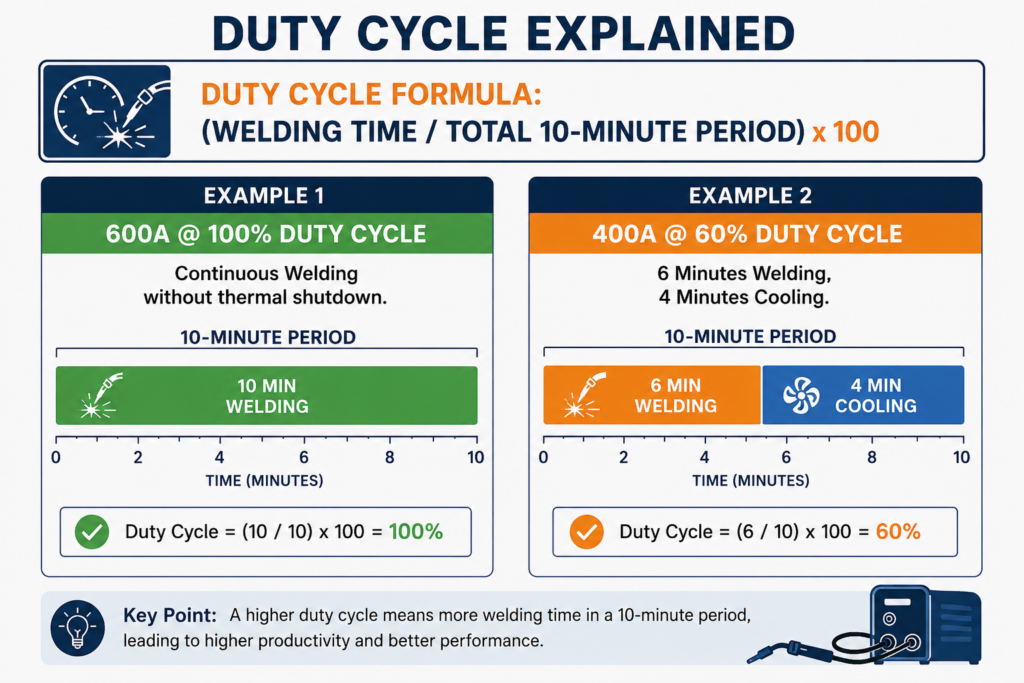
The 100% Duty Cycle Benchmark
In industrial manufacturing, duty cycles are measured over a 10-minute operation window. While light fabrication tools operate at a 40% or 60% duty cycle, high-volume industrial lines require power sources capable of operating at a 100% duty cycle at maximum amperage. This allows for continuous welding without thermal safety shut-offs, maximizing daily output.
Industrial Electrical Infrastructure Compatibility
Industrial facilities utilize three-phase electrical power (typically 380V, 415V, or 440V). It is essential to ensure that your chosen welding system features robust voltage fluctuation compensation. Fluctuations in the plant grid can alter arc characteristics, leading to porosity or lack of fusion. High-tier industrial units include active electronic stabilization to maintain arc consistency even during peak factory power demands.
4. Selecting the Optimal Automation Level for Your Shop Floor
Transitioning from manual welding to automated systems is one of the most effective ways to lower production costs and solve skilled labor shortages. The right degree of automation depends heavily on your part volume and consistency.
Semi-Automated vs. Fully Automated Systems
- Semi-Automated Setups: The operator manually positions the torch or workpiece while the machine manages wire feed speed and arc length. This is ideal for shops with highly varied product geometries.
- Fully Automated Workstations: Dedicated systems handle part positioning, torch movement, and weld parameter adjustments with zero manual intervention during the cycle. This approach provides excellent repeatability and maximizes arc-on time.
Dedicated Special Purpose Machines (SPMs)
When a factory produces identical components continuously, standard articulated robots can sometimes be less efficient than a custom Special Purpose Machine (SPM). For instance, dedicated conveyor roller manufacturing lines integrate pressing, cutting, and dual-torch welding into a single streamlined process. These specialized systems deliver far higher throughput and lower per-unit cycle times than general-purpose robotic arms.
Integrating Material Handling and Positioning Equipment
An automated power source is only as efficient as its positioning system. Integrating column-and-boom manipulators, heavy-duty welding rotators, and precise positioners ensures that the weld joint always remains in the optimal flat position. This integration minimizes defect rates and maximizes deposition speeds.
5. Industrial Application Profiles and Heavy Sector Requirements
Different industries operate under distinct regulatory frameworks and structural standards. Your industrial welding machine selection must align with the specific compliance demands of your target market.
Pressure Vessels, Boilers, and Heavy Chemical Reactors
Fabricating equipment for high-pressure environments requires strict adherence to international codes like ASME Section VIII. Welds must pass 100% radiographic and ultrasonic non-destructive testing (NDT). To achieve this standard consistently, manufacturers rely heavily on automated Narrow Gap SAW and specialized corrosion-resistant cladding systems to avoid manual defects.
Infrastructure, Pre-Engineered Buildings (PEBs), and Railway Girders
The infrastructure sector requires long, uninterrupted structural fillet and groove welds. Equipment configurations for this space typically feature multi-arc tractor setups or dedicated gantry welding systems. These allow for rapid deposition across long steel girders while maintaining minimal distortion.
Heavy Equipment Parts and Automotive Sub-Assemblies
The high-speed nature of the automotive and heavy machinery sectors requires robust resistance welding systems. Utilizing high-capacity Single-Phase AC or Medium Frequency Direct Current (MFDC) spot and projection welders allows for rapid, high-strength joining of sheet metal and brackets without adding weight or filler material.
6. Budget Considerations and Total Cost of Ownership (TCO)
Evaluating a welding system based solely on its upfront purchase price can obscure its long-term operational costs. A thorough financial assessment considers the total cost of ownership across the equipment’s lifecycle.
- Upfront Procurement vs. Long-Term Efficiency: While a premium inverter power source or an automated welding cell requires a higher initial investment, it often yields major returns through reduced power consumption, lower shielding gas waste, and decreased filler metal consumption.
- Consumables and Consumable Longevity: Evaluate the wear rate of contact tips, nozzles, liners, and flux distribution components. Systems designed with optimized cooling paths significantly extend consumable life, reducing small but frequent operational expenses.
- Rework Mitigation Costs: The truest metric of a machine’s value is its ability to prevent defects. A single major structural weld failure can result in rework costs that far outweigh the initial savings of a cheaper power source. Investing in reliable arc controls protects against these hidden expenses.
7. Common Pitfalls to Avoid in Industrial Procurement
Avoiding standard procurement errors protects your shop floor from costly operational bottlenecks and premature equipment replacement.
- Underestimating Future Duty Cycle Demands: Purchasing a machine rated exactly for current needs leaves zero overhead for production scaling. Always specify a power source that can comfortably handle unexpected high-duty runs.
- Ignoring Post-Sales Engineering Support: Complex automated systems require calibration, operator training, and preventative maintenance. Sourcing equipment from suppliers without dedicated regional field engineers can lead to lengthy, costly production delays.
- Mismatched Power Sources and Wire Feed Systems: Using an advanced power source with a low-grade, inconsistent wire feeder causes arc instability, wire burn-back, and increased spatter. Ensure the wire drive motor and control cable architecture match the capability of the power supply.
8. Strategic Implementation for Maximum ROI
Once you have completed your industrial welding machine selection, successful deployment requires an organized onboarding strategy:
- Comprehensive Welder and Operator Training: Even highly automated systems require skilled oversight. Ensure your equipment provider offers structured hands-on training covering parameter programming, safety procedures, and quick troubleshooting.
- Preventative Maintenance Protocols: Establish clear maintenance schedules for cleaning wire feed rollers, verifying shielding gas flow, checking ground connections, and checking coolant levels in water-cooled torches.
- Tracking Key Production Metrics: Monitor arc-on time, deposition rates, defect percentages, and daily energy usage. This data helps verify your return on investment and provides clear insights for planning future factory expansions.
Partner with India’s Leading Welding Automation Experts
Optimizing your production floor requires more than just high-quality power sources—it demands a fully integrated fabrication strategy. At Kaiyuan Welding & Cutting Automation India Pvt. Ltd. (KWAI), we specialize in designing, manufacturing, and deploying advanced industrial welding systems tailored to modern manufacturing.
From heavy-duty Submerged Arc Welding units and precision narrow-gap systems to custom turnkey Special Purpose Machines for roller manufacturing and vessel cladding, our Pune-based engineering team helps you maximize throughput and minimize defect rates.
Don’t leave your equipment procurement to chance. Contact our technical consulting team today to discuss your production goals, material specifications, and automation needs. Let us design an optimized manufacturing system built for long-term reliability and precision.
Explore our complete product line or request a customized technical consultation today.
Frequently Asked Questions (FAQ)
Q1: What are the primary advantages of an MFDC spot welder compared to traditional single-phase AC systems?
Medium Frequency Direct Current (MFDC) systems operate at significantly higher frequencies (typically 1000Hz or more) compared to standard 50Hz AC welders. This allows for highly precise millisecond-level energy control, balanced three-phase electrical loading, reduced power consumption, and cleaner, spatter-free spot welds on sensitive materials like aluminum or galvanized steel.
Q2: Why is Narrow Gap welding preferred for thick-walled pressure vessel manufacturing?
Narrow Gap welding utilizes a highly restricted groove joint configuration, often less than 10 degrees. By narrowing the joint path, the volume of expensive filler metal required is drastically reduced, and the overall arc hours needed to complete the joint drop significantly. This process minimizes the total heat-input zone, reducing thermal distortion and improving metallurgical properties.
Q3: How do I determine if my manufacturing facility needs a customized special purpose machine (SPM) or a flexible robotic welding arm?
If your facility manufactures high volumes of uniform, standardized components (such as idler rollers, conveyor elements, or standard pipes) with minimal geometry changes, a specialized welding automation solution like an SPM provides faster cycle times and lower per-unit costs. If your shop handles highly varied, low-volume product runs with complex, changing geometries, an articulated robotic arm offers better long-term operational flexibility.
Q4: What role does active voltage compensation play in industrial power sources?
In large heavy industrial facilities, the electrical grid frequently experiences sudden voltage drops or surges when heavy machinery restarts. Active voltage compensation ensures the welding power source automatically stabilizes the output current. This prevents arc cutting, porosity, and incomplete fusion defects, keeping the weld quality consistent regardless of external electrical grid fluctuations.
Q5: How can I verify compliance with ASME welding standards during machine setup?
To comply with codes like ASME Section IX, you must document and qualify your Welding Procedure Specification (WPS). Ensure your selected industrial machine features digital parameter tracking and precision readouts for amperage, voltage, and travel speed. This allows your quality control team to accurately verify that the physical arc parameters align perfectly with your approved qualified procedures. For detailed code requirements, check the official standards on the American Society of Mechanical Engineers (ASME) platform.