
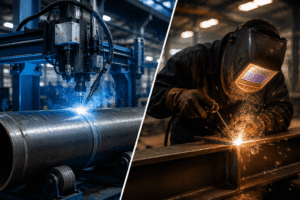
Automatic Welding Machine vs Manual Welding: Which Is Better for Industry?
The manufacturing landscape is undergoing a massive shift driven by technological advancement. Industrial production demands speed, precision, and cost-effectiveness to remain competitive in a crowded global marketplace. At the center of this evolution is a fundamental decision that workshop owners, production managers, and enterprise executives must make: Automatic Welding Machine vs Manual Welding: Which Is Better for Industry? Choosing the correct fabrication methodology directly impacts your operational throughput, labor dynamics, and bottom-line profitability.
For decades, traditional manual welding has been the bedrock of structural fabrication, custom manufacturing, and heavy industrial assembly. However, as global market demands put a premium on rapid scaling and flawless consistency, the industrial reliance on the classic automatic welding machine has surged. Deciding between these two paths is not merely a matter of comparing tools; it requires a deep, strategic analysis of production volume, structural requirements, and long-term capital expenditure.
This comprehensive guide analyzes the functional mechanisms, economic realities, and hidden trade-offs of automated versus manual welding processes. By exploring how each system performs under industrial pressures, you will gain the clarity required to make an informed, forward-looking investment for your facility.
The Fundamentals of Modern Industrial Welding
To understand which approach suits your operations, we must first break down the technological definitions and practical workflows that separate automated systems from manual craftsmanship.
Defining the Automatic Welding Machine
An automatic welding machine refers to an integrated system where mechanical components, electronic sensors, and programmable logic controllers (PLCs) execute the welding process without continuous human intervention. Once a technician configures the operational parameters—such as travel speed, voltage, wire feed rate, and torch positioning—the machine executes high-precision welds with absolute uniformity.
These setups often incorporate specialized sub-components, such as an advanced welding oscillator, which mechanically weaves the welding torch across a joint. This automated oscillation mimics the complex hand movements of a master welder but maintains a level of geometric consistency that no human can duplicate over an eight-hour shift.
Defining Manual Welding Processes
Manual welding relies entirely on the physical dexterity, visual judgment, and spatial awareness of a human operator. Processes like Shielded Metal Arc Welding (SMAW/Stick), Gas Tungsten Arc Welding (GTAW/TIG), and manual Gas Metal Arc Welding (GMAW/MIG) require the welder to manually strike the arc, feed the filler material, and guide the torch along the weld seam.
While manual welding offers unparalleled adaptability in tight spaces or on highly complex, non-repetitive geometries, it is inherently limited by human fatigue, cognitive drift, and physical variation.
Automatic Welding Machine vs Manual Welding: Direct Comparison
| Feature / Metric | Automatic Welding Machine | Manual Welding |
| Production Speed & Output | Extremely high; continuous operation with zero fatigue. | Limited by human endurance, rest breaks, and setup times. |
| Weld Quality & Consistency | Flawless, repeatable welds; minimal reject rates. | Highly dependent on individual welder skill and fatigue levels. |
| Initial Capital Investment | High upfront cost for equipment, software, and integration. | Low initial cost; requires basic power sources and safety gear. |
| Long-Term Operational Costs | Low per-part cost; optimized consumable and gas usage. | High per-part cost due to ongoing labor rates and material waste. |
| Operational Flexibility | Best suited for standardized, high-volume, repetitive tasks. | Exceptionally flexible; adapts instantly to varied job types. |
| Safety & Risk Profile | Isolates operators from toxic fumes, radiation, and heat. | High exposure to weld spatter, hazardous gases, and flash burns. |
Core Advantages of an Automatic Welding Machine
When analyzing an industrial transition to automation, the advantages extend far beyond simply replacing manual labor. Automated infrastructure redefines the entire production paradigm through several key metrics:
1. Maximizing Throughput and Production Speed
In high-volume manufacturing environments, time is quite literally currency. An automatic welding machine operates at travel speeds that far outpace even the fastest human operators. Because automated systems do not experience physical fatigue, they can maintain maximum operational speeds continuously across multiple shifts.
Furthermore, automation minimizes the non-productive downtime typically spent changing electrodes, cleaning slag, or readjusting positioning between tasks. By combining automated welding torches with specialized welding rotators, large cylindrical vessels or heavy piping can be spun smoothly beneath a fixed welding head, creating a continuous, uninterrupted workflow that slashes production cycle times by up to 70%.
2. Flawless Structural Integrity and Repeatability
In industries such as aerospace, automotive manufacturing, and pressure vessel fabrication, a single weld failure can lead to catastrophic structural accidents or costly legal liabilities. Automated systems remove human variability from the equation.
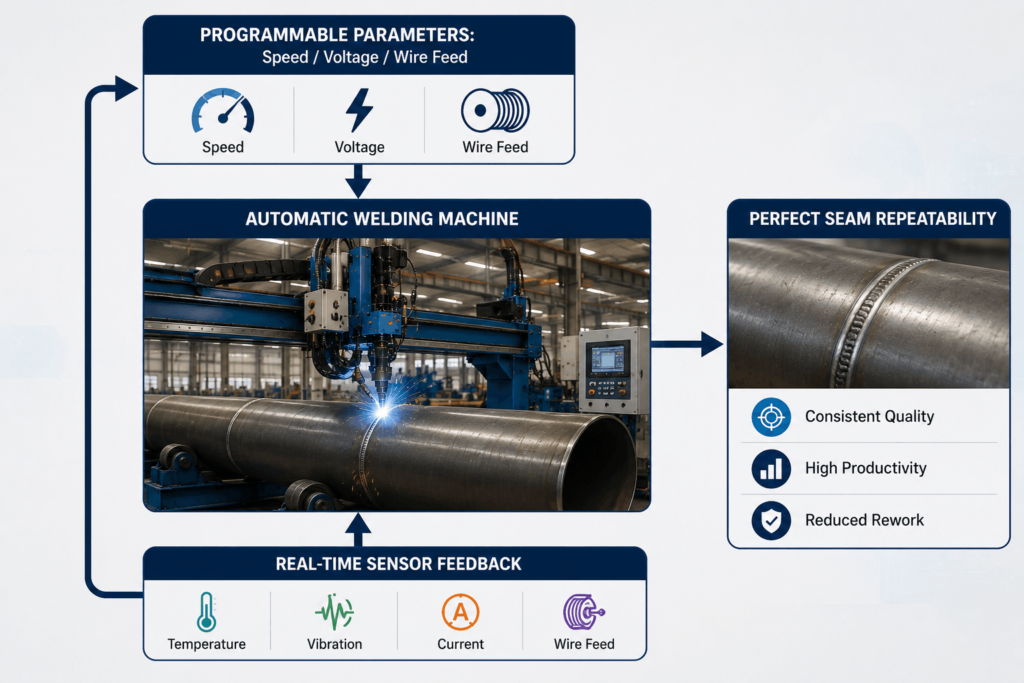
When an automated machine is programmed to execute a specific seam, it delivers identical bead profiles, penetration depths, and microstructural properties every single time. This level of precision minimizes internal weld defects like porosity, lack of fusion, or undercut, ensuring your products easily pass stringent non-destructive testing (NDT) protocols.
3. Substantial Reduction in Material Waste and Consumable Costs
Manual welding is notorious for material variance. A welder may inadvertently over-weld a joint, using more filler wire and shielding gas than the engineering specifications require. Over time, these small discrepancies accumulate into thousands of dollars in wasted materials.
An automatic welding machine consumes exactly the calculated volume of wire, flux, or gas required for the joint design. Additionally, because automated welds rarely fail quality checks, companies can virtually eliminate the expenses associated with grinding out, re-prepping, and re-welding defective components.
Understanding the Limitations of Automated Systems
Despite its profound operational advantages, automation is not a universal solution for every fabrication business. Understanding its constraints is critical for preventing misallocated capital.
- High Initial Financial Outlay: The primary barrier to adopting an automatic welding machine is the upfront capital expenditure. Purchasing the core machine, integrating custom fixtures, buying automated positioning equipment, and training personnel requires a major financial commitment. For small workshops with limited cash flow, this initial hurdle can be difficult to clear.
- Prolonged Setup and Programming Cycles: Automated systems require meticulous programming, calibration, and physical part fixture design before the first production arc is struck. If your facility deals with low-volume, highly customized, or single-run jobs, the time spent configuring the automated system can easily exceed the time it would take a skilled manual welder to finish the project.
- Rigid Spatial Constraints: Machines lack the inherent spatial problem-solving capabilities of human beings. An automated system cannot easily squeeze inside an irregularly shaped chamber, climb a field-bound structural asset, or alter its path on the fly to compensate for poorly cut raw materials.
The Value Proposition of Manual Welding in Modern Industry
While automation dominates high-volume production lines, manual welding remains a vital and irreplaceable asset across various industrial sectors.
Unmatched On-Site Flexibility and Mobility
The greatest strength of manual welding is its mobility. A field welder equipped with a portable inverter power source can operate on structural job sites, offshore oil platforms, or remote pipeline networks. Humans can adapt instantly to unpredictable real-world variables, adjusting their torch angle, travel speed, and technique to accommodate shifting wind conditions, awkward physical angles, or varying root gap dimensions.
Low Entry Costs and Rapid Deployment
From an operational perspective, setting up a manual welding workstation is incredibly simple and affordable. The capital required to purchase a high-quality manual power source, cables, and personal protective equipment (PPE) is minimal. This allows small-scale enterprises, custom fabrication garages, and maintenance departments to establish fully functional welding capabilities without taking on restrictive corporate debt.
Strategic Creativity in Custom Projects
For prototype development, architectural metal art, and short-run custom fabrications, manual welders are indispensable. They bring cognitive problem-solving skills to the workshop floor, allowing them to interpret complex engineering blueprints, adjust for unexpected material warpage, and execute diverse joint configurations without needing thousands of lines of software code rewritten.
Crucial Industrial Drivers: How to Choose Your Path
To determine whether an automatic welding machine or a manual approach is ideal for your enterprise, you must objectively evaluate several core industrial drivers:
Production Volume and Standardized Geometry
If your product catalog consists of standardized parts with predictable, repeating geometric shapes (such as straight seams, circles, or predictable curves), your operation is prime for automation. High production volumes allow you to amortize the initial cost of an automatic welding machine across thousands of identical units, driving down your per-part manufacturing costs. Conversely, if your facility focuses on job-shop repairs or bespoke, custom-engineered builds, manual welding is the more logical choice.
Labor Shortages and Evolving Welder Dynamics
The global manufacturing sector faces an escalating crisis: a severe shortage of certified, highly skilled manual welders. As an aging generation of experienced fabricators retires, younger workers are rarely entering the trade fast enough to fill the void. This talent gap drives up manual labor costs and slows down production timelines.
Investing in an automatic welding machine allows you to optimize your workforce. A single technician can oversee multiple automated cells, magnifying your production capacity without requiring you to hire scarce and expensive specialized manual labor.
Workspace Safety and Regulatory Compliance
Welding environments are inherently hazardous, exposing operators to extreme heat, blinding ultraviolet light, and toxic airborne particulates. For detailed guidance on maintaining a secure industrial floor, you can review the comprehensive safety frameworks established by the Occupational Safety and Health Administration (OSHA).
By transitioning high-risk, heavy-duty welding processes to automated machinery, you move human operators out of the immediate danger zone and into control booths or monitoring stations. This proactive safety measure dramatically reduces workplace injuries, lowers workers’ compensation insurance premiums, and ensures strict compliance with modern industrial safety regulations.
Hybrid Ecosystems: Combining Automation and Human Skill
Choosing between these methods does not have to be an all-or-nothing decision. In fact, many of the world’s most profitable manufacturing facilities deploy a hybrid strategy that leverages the strengths of both systems.
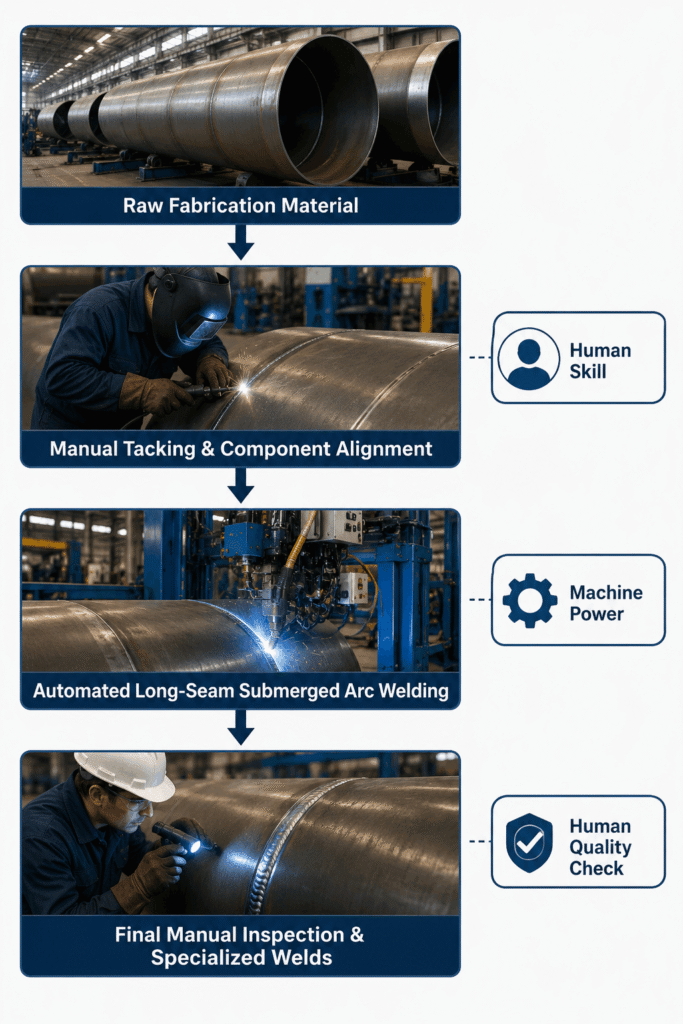
In a hybrid production workflow, human welders are used to handle complex component fit-up, tack-welding structural frames together, and executing highly intricate, hard-to-reach joints. Once the complex prep work is complete, the assemblies are loaded onto heavy-duty welding positioners and welded out using automated machinery. This collaborative approach maximizes structural integrity, optimizes shop floor throughput, and keeps operational costs tightly controlled.
Driving Industrial Efficiency with Kaiyuan Innovation
Scaling your fabrication business requires dependable equipment designed to handle rigorous, multi-shift manufacturing demands. Kaiyuan specializes in engineering advanced industrial automation systems that help facilities transition away from slow, inconsistent manual processes and move into high-efficiency automated production.
Our extensive engineering catalog includes high-capacity column and boom manipulators, precision welding rotators, and custom-designed automated systems built to handle challenging heavy fabrication tasks. Whether you need to streamline your heavy pressure vessel manufacturing, upgrade structural steel output, or implement a turnkey automated cell, our technical team delivers the heavy equipment and engineering expertise required to maximize your operational ROI.
Elevate Your Production Infrastructure Today
Are you ready to eliminate production bottlenecks, insulate your business from skilled labor shortages, and dramatically improve your welding quality? Don’t let outdated manual processes hold back your organizational growth.
Contact the Industrial Automation Experts at Kaiyuan Today to speak with a dedicated applications engineer. We will review your production blueprints, analyze your cycle time targets, and build a tailored automated welding solution designed to scale your business profit margins.
Industrial Welding: Frequently Asked Questions
1.What is the primary difference when comparing an automatic welding machine vs manual welding?
The primary difference lies in control and execution. An automatic welding machine utilizes pre-programmed software, electronic sensors, and mechanical systems to control travel speed, torch positioning, and arc characteristics with perfect repeatability. Manual welding relies entirely on the physical skill, visual focus, and hand-to-eye coordination of a human operator, making it more flexible but highly vulnerable to fatigue and human error.
2.Can an automatic welding machine handle low-volume, custom fabrication work?
Generally, no. Automated welding systems require significant setup time, physical fixturing design, and precise software programming. For small batches or one-off custom parts, the time and cost required to set up the automation typically outweigh the time it would take a skilled manual welder to complete the job directly.
3.How does automated welding improve safety on the manufacturing floor?
Automated systems allow human operators to monitor the fabrication process from a safe distance. This dramatically reduces direct human exposure to hazardous metal fumes, intense arc radiation, high temperatures, and flying weld spatter, leading to fewer workplace injuries and a healthier workforce.
4.What industries benefit most from investing in automated welding systems?
Industries that rely on high-volume production, long continuous weld seams, or repetitive geometric parts see the highest return on investment. This includes pressure vessel manufacturers, automotive assembly plants, shipyard pipe fabrication facilities, structural beam manufacturing, and large-scale tank construction.
5.Is manual welding becoming completely obsolete because of automation?
Absolutely not. Manual welding remains essential for field construction, maintenance and repair operations, complex architectural metalwork, and environments with unpredictable joint gaps or tight physical spaces where bulky automated machinery cannot fit.