
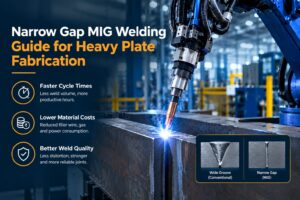
How Narrow Gap MIG Welding Reduces Cycle Times and Material Costs in Heavy Plate Fabrication
Heavy plate fabrication represents one of the most demanding segments of modern industrial manufacturing. Whether constructing thick-walled pressure vessels, massive railway girders, or critical infrastructure components, structural integrity is non-negotiable. Historically, joining thick metal sections ranging from 50 mm to over 150 mm required wide-bevel joint preparations—such as conventional V-grooves or U-grooves with included angles ranging from 45 to 60 degrees. While these legacy configurations provided sufficient access for manual or semi-automated torches, they introduced a massive geometric penalty: an exponential increase in the volume of weld metal required to fill the joint. Consequently, fabricators faced prolonged cycle times, high power consumption, excessive filler wire consumption, and severe thermal distortion.
Enter narrow gap MIG welding—an advanced variant of the conventional Gas Metal Arc Welding (GMAW process) engineered specifically to overcome these bottlenecks. By drastically reducing the groove angle down to parallel or near-parallel dimensions (often between 2 and 10 degrees), this innovative technique minimizes the weld cavity cross-section. This comprehensive guide explores how implementing narrow gap MIG welding transforms heavy fabrication workflows, slashes operational expenses, preserves crucial mechanical properties, and delivers unprecedented metallurgical soundness.
Understanding the Mechanics of narrow gap MIG welding
To appreciate the economic and structural advantages of narrow gap MIG welding, one must first examine how the process fundamentally differs from conventional multi-pass welding. In a traditional wide-groove setup, operators deposit multiple stringer or weave beads layer by layer, progressively widening the weld pool as the joint opens toward the surface. This method requires massive amounts of filler metal and subjects the parent material to prolonged thermal cycles.
In contrast, narrow gap MIG welding utilizes a restricted joint profile—often classified as a tight I-groove or a slender U-preparation. Because the sidewalls are nearly parallel, the welding torch must be specially engineered to deposit sound metal uniformly across a confined space without risking lack of fusion against the vertical walls. Advanced systems achieve this through specialized contact tips, magnetic arc oscillation, or rotating arc mechanisms that intentionally direct the energy toward the sidewalls.
By adopting narrow groove welding technology, fabricators can deposit a single weld pass per layer in a predictable, highly repeatable sequence. This precise control over energy distribution ensures complete root penetration while keeping the total volume of deposited weld metal to an absolute minimum.
Overcoming Traditional Hurdles Through thick plate welding process Innovations
Thick plate fabrication has always battled two primary enemies: angular distortion and metallurgical degradation caused by excessive heat input. When welding plates exceeding 50 mm in thickness using conventional methods, dozens—or even hundreds—of passes may be required. Each successive pass introduces thermal energy into the weldment, creating steep thermal gradients that result in warping, residual stresses, and microstructural coarsening in the heat-affected zone (HAZ).
The integration of an optimized thick plate welding process built around narrow gap principles directly neutralizes these issues:
- Elimination of Wide Thermal Footprints: Confining the electric arc to a tight space restricts heat dispersion, localizing thermal effects strictly to the fusion zone.
- Drastic Mitigation of Angular Distortion: Because the joint volume is symmetric and narrow, transverse shrinkage forces are balanced across the neutral axis, virtually eliminating angular distortion and reducing the need for post-weld straightening.
- Enhanced Deposition Efficiency: High-duty cycle automated equipment maintains consistent travel speeds and wire feed rates, ensuring predictable metallurgical structures throughout deep joints.
Achieving Substantial filler wire cost reduction
For heavy fabrication enterprises, consumable expenses represent a major portion of the operational budget. In wide-groove configurations, up to 80% of the deposited metal serves merely to fill the volumetric void created by the wide bevel angle. This inefficiency translates into thousands of kilograms of wasted filler wire, shielding gas, and electrical power per large project.
By shrinking the groove volume, narrow gap MIG welding achieves an immediate and profound filler wire cost reduction. For instance, shifting from a standard 60-degree V-prep to a tight 5-degree narrow groove can decrease weld metal volume by up to 70% to 80%. This reduction cascades across multiple operational fronts:
- Direct Material Savings: Purchasing significantly fewer spools of solid wire translates into immediate bottom-line savings.
- Reduced Shielding Gas Consumption: Fewer total passes mean the active shield gas mixture (such as Argon-CO2 blends) is flowed for a fraction of the time, lowering auxiliary gas expenditures.
- Minimized Power Consumption: Shorter total arc-on times directly reduce electrical grid draw per finished assembly.
Optimizing Parameters: Wire Oscillating Frequency and Shielding Dynamics
Executing a flawless narrow gap weld requires rigorous control over electro-mechanical variables. Because the sidewalls are in close proximity, standard torch positioning is insufficient. Modern automated systems rely on precise adjustments to ensure defect-free sidewall tie-in.
Managing wire oscillating frequency
To prevent lack of fusion—a common defect in confined spaces—the welding head often incorporates mechanical or magnetic oscillation. Tuning the wire oscillating frequency and dwell time at the extremities of the groove ensures that the arc thoroughly melts the parent sidewall before sweeping back across the center. This dynamic movement guarantees clean inter-run fusion without requiring an excessively wide gap.
The Role of the shield gas mixture
Protecting the molten pool deep inside a narrow channel requires laminar gas coverage free of turbulence. Optimizing the shield gas mixture—typically combining high-purity argon with controlled percentages of carbon dioxide or oxygen—stabilizes the metal transfer mode, minimizes spatter, and prevents atmospheric contamination from causing porosity in deep-set passes.
Preserving mechanical properties preservation in Heavy Structures
A common concern among structural engineers is whether reducing heat input and altering thermal cycles compromises the mechanical integrity of high-strength steels. Fortunately, research and industrial case studies confirm that narrow gap techniques support superior mechanical properties preservation.
Traditional thick-plate multi-pass welds often suffer from cumulative tempering effects that can degrade toughness in the HAZ. By utilizing a low heat input welding strategy, the width of the HAZ is significantly restricted, preserving the fine-grained microstructure of the parent metal. Furthermore, fewer passes mean lower cumulative residual stress, reducing susceptibility to cold cracking and stress corrosion cracking in demanding service environments. Charpy V-notch impact toughness values remain exceptionally high, satisfying rigorous codes for structural and pressure-containment applications.
Sector-Specific Applications: From pressure vessel jointing to railway girder fabrication
The versatility and economic efficiency of narrow gap technology have driven its adoption across critical heavy industries where joint failure is catastrophic.
Heavy pressure vessel jointing
Pressure vessels operating under extreme internal pressures and elevated temperatures demand absolute flaw-free weld integrity. Utilizing narrow gap automation for longitudinal and circumferential seams on thick-walled cylindrical shells ensures uniform penetration, reduces inspection rework via non-destructive testing (NDT), and guarantees compliance with international ASME and ISO pressure equipment codes.
Heavy-Duty railway girder fabrication
In civil engineering and heavy transport manufacturing, railway girder fabrication requires joining ultra-thick structural steel plates that must withstand cyclic fatigue loads over decades of service. Narrow gap automation provides the deep, uniform root penetration and high joint ductility necessary to handle massive dynamic loads without structural degradation.
Comparative Analysis: Traditional V-Groove vs. Narrow Gap Automation
| Parameter | Conventional Wide-Groove MIG | Narrow Gap MIG Welding |
| Groove Angle | 30° to 60° included angle | 2° to 10° parallel or near-parallel |
| Weld Metal Volume | Extremely high; requires substantial filler | Reduced by up to 70%–80% |
| Cycle Time | Extended due to dozens of required passes | Dramatically shortened via rapid single-pass-per-layer execution |
| Heat Input | High cumulative thermal input, leading to distortion | Controlled low heat input welding, minimal warping |
| Post-Weld Machining/Grinding | Extensive cleaning and grinding required | Minimal post-processing needed |
Elevate Your Heavy Fabrication Line with Kaiyuan Automation
Transitioning from legacy wide-bevel methods to cutting-edge narrow gap automation requires specialized engineering expertise, robust machinery, and meticulous procedure development. At Kaiyuan Automation, we specialize in delivering state-of-the-art welding solutions engineered specifically for heavy plate fabrication, pressure vessel manufacturing, and structural engineering plants. Whether you are looking to integrate advanced power sources, custom torch oscillation systems, or fully automated robotic workstations, our team provides comprehensive technical support, seamless integration, and proven shop-floor reliability.
Optimize your production floor, eliminate unnecessary consumable waste, and achieve flawless structural output with our trusted industrial automation solutions.
Frequently Asked Questions (FAQs)
What is the primary advantage of narrow gap MIG welding over conventional methods?
The primary advantage is the massive reduction in weld metal volume, which cuts filler wire consumption by up to 80%, shortens cycle times, and minimizes thermal distortion in thick plates.
What plate thicknesses are best suited for narrow gap welding?
The process is typically deployed for components exceeding 50 mm in thickness, where traditional wide-groove preparations become economically and metallurgically inefficient.
How does narrow gap welding prevent lack of fusion on the sidewalls?
Modern systems utilize specialized contact tips, magnetic steering, or controlled mechanical wire oscillating frequency to direct the arc energy squarely against the vertical sidewalls.
Can narrow gap welding be integrated into automated robotic cells?
Yes, narrow gap technology is highly adaptable to mechanized and robotic systems, ensuring consistent bead placement, high repeatability, and enhanced operator safety.