Maximizing Throughput with Dual Torch Horizontal Welding Machines in Industrial Automation
In modern heavy manufacturing, maintaining a competitive edge requires rapid production cycles, low labor overhead, and high structural integrity. Integrating a dual torch horizontal welding machine into your line can transform high-volume fabrication. By executing two welds simultaneously, this high-efficiency system eliminates output bottlenecks and ensures consistent joint quality across all workpieces.
Fabrication lines handling heavy tubes, structural beams, pressure vessels, and conveyor rollers often encounter productivity limits when relying on manual welding or single-torch setups. A dual torch horizontal welding machine addresses these issues by delivering balanced heat distribution, reducing part deformation, and doubling linear welding output.
This comprehensive guide details how dual-torch systems operate, how they compare to alternative joining methods, and how Kaiyuan Welding & Cutting Automation equips manufacturers with custom automated systems designed for continuous industrial output.
1. The Core Engineering of Dual Torch Horizontal Welding Systems
A dual torch horizontal welding system is a specialized automated unit engineered to hold cylindrical or structural workpieces in a horizontal orientation. While the workpiece rotates or remains clamped in place, two independent welding heads operate concurrently to apply uniform filler material.
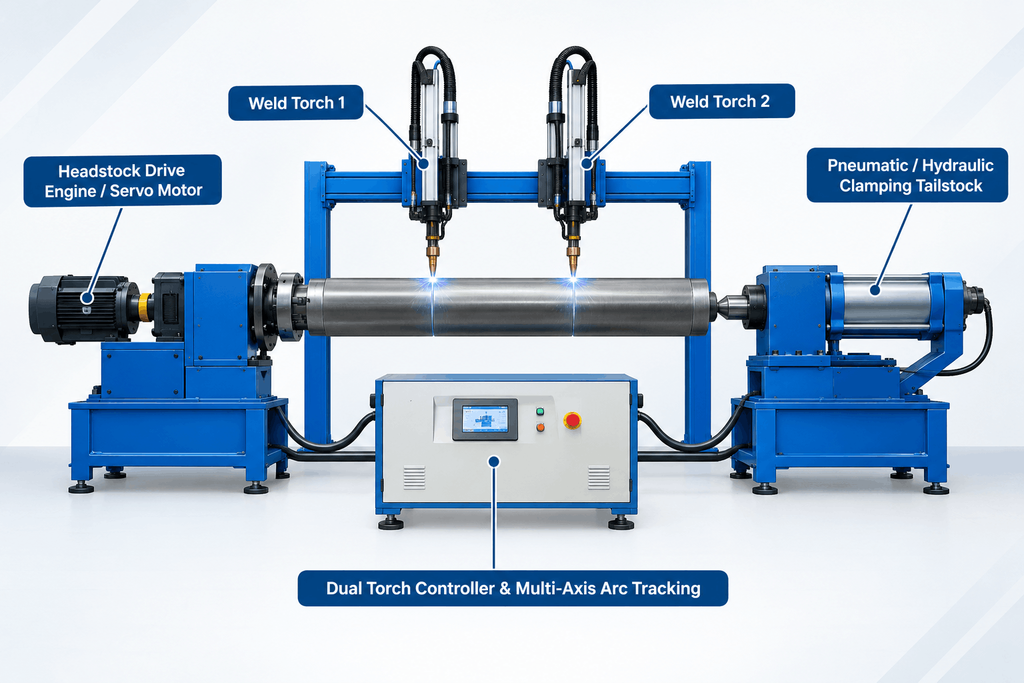
Key Mechanical Components
- Heavy-Duty Horizontal Bed & Lathe Structure: Keeps long pipes, shafts, and cylinders aligned without sagging during high-temperature cycles.
- Dual Torch External Welding System Assembly: Supports tandem or dual-head arc alignment. Each head features independent multi-axis adjustability (X, Y, Z coordinates) to maintain precise contact tip-to-work distance (CTWD).
- Multi-Torch Welding Head Assembly: Allows operators to adjust torch angles, weave parameters, and interpass distance based on material thickness and seam geometry.
- Synchronized Servo Drives & Controls: Controls rotation speed and torch travel rate, ensuring smooth metal deposition without undercut or lack of fusion.
By running two arcs in a single pass, thermal stress is distributed symmetrically across the seam. This balanced thermal profile reduces warping and post-weld straightening—a common challenge in heavy tube fabrication and structural assembly.
2. Key Throughput Advantages for Industrial Applications
1. Cycle Time Reduction
The primary benefit of a dual torch horizontal welding machine is an immediate 40% to 50% decrease in welding cycle time. Welding both circumferential ends of an idler roller or applying two parallel longitudinal seams simultaneously completes parts in half the time required by single-torch machines.
2. Symmetrical Heat Input
Uneven heat distribution leads to component warping, angular distortion, and internal stresses. Symmetrical heat application from opposing torches maintains the axial alignment of long tubes and shafts, lowering scrap rates and avoiding costly rework.
3. Integrated Process Automation
Modern units combine arc welding with automatic clamping, seam tracking, and flux recovery (for submerged arc processes). These features minimize operator handling, limit human error, and keep the arc active across long production shifts.
3. Technology Comparison: Dual Torch vs. Alternative Automated Systems
To select the right machinery for your floor, evaluate how a two torch horizontal welding machine compares against other automated processes.
| Feature / Metric | Dual Torch Horizontal Machine | Spot Welding Robots | Single-Torch Longitudinal Seam Welder | Automated Cladding Machine |
| Primary Joint Type | Continuous Circumferential & Longitudinal | Resistance Lap Joints & Spot Fusion | Single-Pass Seam Welding | Surface Overlay & Corrosion Protection |
| Deposition Rate | Very High (Dual Arc) | N/A (Solid-State Join) | Medium | High (Layer Deposition) |
| Deposition Geometry | Horizontal Cylinders & Tubes | Sheet Metal Components | Flat / Plate & Pipe Seams | Internal / External Surfaces |
| Distortion Management | Excellent (Balanced Arc Heat) | High (Localized Pinch Points) | Moderate (Requires Pre-Heating) | Moderate (High Heat Input) |
| Ideal Production Style | High-Volume Tube / Pipe Lines | Automotive Sheet Assembly | Mid-Volume Plate Fabrication | High-Wear Heavy Components |
Comparative Insights
- Versus Spot Welding Robots: Spot welding excels at sheet-metal lap joints, but lacks the strength required for pressure-retaining or heavy load-bearing continuous seams.
- Versus Longitudinal Seam Welders: Standard single-torch longitudinal seam welder units are useful for basic flat plate work, but lack the dual-arc capacity needed for balanced, double-pass circumferential joints.
- Versus Automated Cladding Machines: An automated cladding machine is built for anti-corrosion overlay deposition, whereas dual-torch horizontal systems focus on deep-penetration structural joining.
4. Heavy-Duty Manufacturing Applications
Automated welding cutting automation equipment is widely deployed across demanding heavy industries:
1. Idler Roller & Conveyor Assembly Lines
Bulk material handling systems depend on thousands of durable idler rollers. A two torch horizontal welding machine seals both end caps onto the roller body at the same time, producing concentric, leak-tight joints at high production speeds.
2. Pressure Vessels & Heavy Tubes
Fabricators handling heavy-wall pipes use narrow gap welding techniques alongside dual-torch systems. Placing two torches in a narrow-groove joint reduces filler wire consumption while maintaining deep weld penetration across thick sections.
3. Hydraulic Cylinder Manufacturing
Hydraulic barrels require consistent weld penetration without burning through the cylinder wall. Programmed arc controls deliver uniform, repeatable seams that withstand high hydraulic pressures.
4. Railway Girders & Axle Components
Infrastructure components must satisfy strict non-destructive testing (NDT) criteria. Dual-torch systems provide consistent heat control and joint fusion, lowering the risk of slag inclusions, porosity, or incomplete penetration.
5. Integrating Advanced Welding Technologies
Achieving peak production requires matching the physical machine structure with the right welding process and control systems:
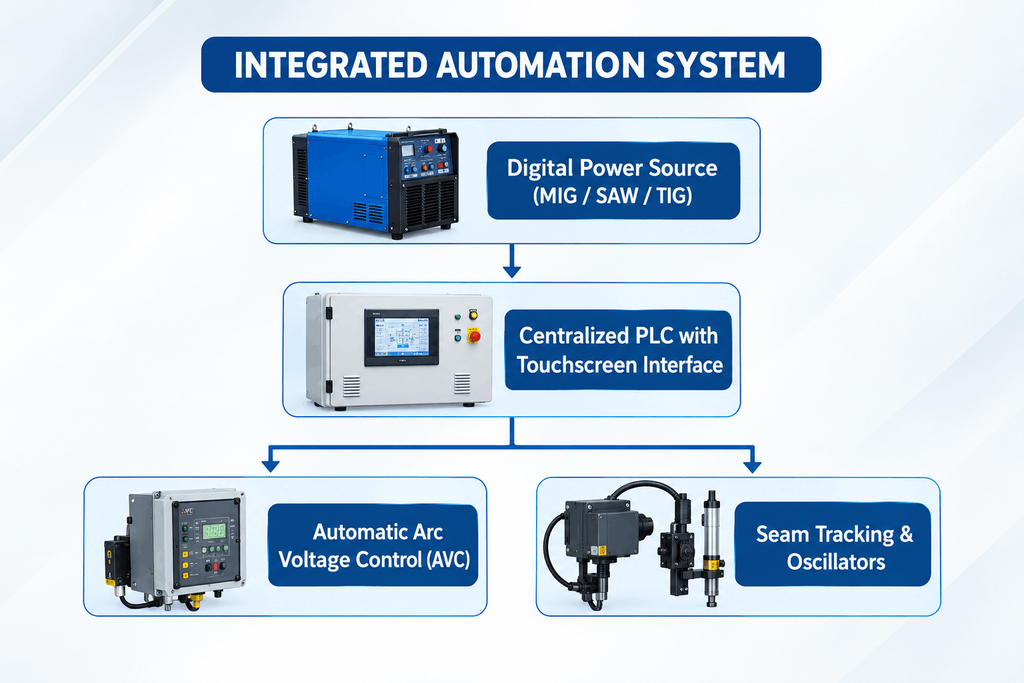
- Multi-Process Compatibility: Dual horizontal machines can integrate Gas Metal Arc Welding (GMAW/MIG), Submerged Arc Welding (SAW), or Gas Tungsten Arc Welding (GTAW/TIG), depending on material thickness and metallurgical needs.
- Narrow Gap Welding Technology: Using specialized narrow-groove torch geometries reduces bevel angles from 60 degrees down to 2–5 degrees. This saves filler wire, cuts power usage, and speeds up travel times.
- Automatic Arc Voltage Control (AVC): AVC maintains constant arc length across minor surface variations, keeping weld bead dimensions uniform.
- Motorized Weaving & Seam Tracking: Optical or tactile tracking sensors follow seam wander in real time, adjusting torch positions without manual operator intervention.
6. Implementation Strategy: Integrating Dual Torch Machines
Upgrading to automated dual-torch welding requires a structured rollout to ensure smooth integration on the shop floor:
1.Assess Joint Geometry & Production Requirements:Define part parameters prior to machinery selection.
Evaluate component dimensions, wall thicknesses, material grades, and daily target volumes. Determine whether the line requires a specialized circumferential unit or a combination seam welding cell.
2.Optimize Joint Preparation & Upstream Tooling:Precision input ensures high-quality output.
Automated dual-torch arcs require consistent fit-up and edge prep. Standardize cutting, chamfering, and tacking steps to avoid joint gaps that exceed machine tracking limits.
3.Configure Mechanical & Electrical Automation Controls:Tailor power sources and seam-tracking hardware.
Select matching power sources, wire feeders, and motorized slide packages. Verify that the system includes intuitive PLC touchscreens for managing torch positioning, weave patterns, and rotation speeds.
4.Run Pilot Testing & NDT Quality Verification:Validate penetration and structural integrity.
Execute trial welds on production workpieces. Conduct ultrasonic, radiographic, or cross-sectional etch testing to confirm full penetration, clean sidewall fusion, and zero porosity.
5.Train Operators & Establish Preventive Maintenance:Protect long-term system performance.
Train operators on digital control management, contact tip replacement, and torch alignment. Set routine maintenance schedules for drive rolls, linear guides, and ground clamps.
Technical Specifications Guide
To support equipment selection, the table below outlines core parameters for an industrial-grade dual torch horizontal welding machine operating with MIG or Submerged Arc processes:
| System Parameter | Typical Industrial Range |
| Supported Workpiece Diameter | 50 mm to 1,200 mm (Customizable) |
| Max Workpiece Length | 1,000 mm to 6,000 mm |
| Welding Process Options | GMAW (MIG/MAG), SAW (Submerged Arc), GTAW (TIG) |
| Groove Configuration | Standard V-Groove, J-Prep, or narrow gap welding (1°–3°) |
| Drive Rotation Speed | 0.1 to 3.0 RPM (VFD/Servo-controlled) |
| Torch Slide Adjustment (X/Y/Z) | Motorized 100 mm–300 mm with AVC tracking |
| Target Deposition Rate | 6.0 to 18.0 kg/h (Combined Dual Torch Output) |
Partner with Kaiyuan Automation for Custom Fabrication Lines
Navigating the shift from manual or single-torch setups to high-speed automation requires strong technical support. Kaiyuan Welding & Cutting Automation India Pvt. Ltd. provides advanced, high-performance manufacturing equipment tailored to your exact floor layout and production requirements.
Our engineering team delivers end-to-end automation solutions:
- Explore our complete line of custom welding automation solutions built for demanding industrial environments.
- Discover specialized narrow gap submerged arc welding systems engineered for thick-wall pressure vessels and heavy structural applications.
- Upgrade idler roller lines with specialized end-cap welding units, or deploy high-capacity cladding systems for extended component service life.
For reputable industry benchmarks and welding process standards, review technical guidance provided by the American Welding Society (AWS) and research insights on automated joining systems from the TWI Global Engineering Institute.
Request a Consultation & Live Machine Demo
Ready to eliminate production bottlenecks, reduce labor costs, and improve seam consistency? Contact the technical experts at Kaiyuan Welding & Cutting Automation India Pvt. Ltd. today. Our Pune demonstration center offers live machine evaluations and joint sample testing to help you identify the right dual-torch system for your plant.
Frequently Asked Questions (Q&A)
Q1: How does a dual torch horizontal welding machine double output compared to single-torch setups?
A dual torch machine features two independently controlled welding heads operating on the same workpiece concurrently. By completing two circumferential welds or two parallel longitudinal seams in a single rotation or pass, production cycle times are cut in half.
Q2: Can a dual torch external welding system process different pipe diameters on the same line?
Yes. Modern dual torch machines use adjustable bed rollers, tailstocks, and 3-axis motorized torch slides. Operators can reconfigure parameters through the touchscreen interface to handle varying tube lengths, diameters, and wall thicknesses.
Q3: What is the main advantage of using narrow gap welding on horizontal dual torch machines?
Narrow gap welding narrows the groove angle to between 1 and 3 degrees. Combined with a dual-torch setup, it significantly reduces filler wire volume, decreases total heat input, prevents burn-through, and speeds up pass times on thick-walled pipes and pressure vessels.
Q4: How do automated dual torch systems handle joint tracking variations?
Systems integrate Automatic Arc Voltage Control (AVC), motorized tactile probes, or optical laser seam trackers. These components monitor the joint path in real time and automatically adjust torch positions to maintain steady arc performance and proper wire position.
Q5: Is dual torch horizontal welding suitable for thin-walled tubing?
Yes, provided the power sources support pulsed-MIG or precision TIG welding. Pulsed arc modes control heat input to prevent burn-through, while dual torches ensure balanced travel speeds across the seam.