When undertaking heavy structural fabrication, pressure vessel manufacturing, or shipbuilding, choosing the right welding equipment directly influences your operational productivity, weld integrity, and profit margins. Among high-output joinery methods, a industrial-grade submerged arc welding machine remains the gold standard for continuous, high-speed, and heavy-plate applications. By burying the electric arc beneath a blanket of granular compound, this process delivers deep penetration, zero spatter, and exceptionally high mechanical properties.
However, investing in industrial equipment requires a complete understanding of the entire ecosystem. A reliable submerged arc welding machine operates as a synchronized unit alongside specific wire feeding mechanisms, robust power sources, power regulation units, and flux recovery systems. Whether you are setting up a new production facility or upgrading legacy transformers, this detailed buyer’s guide breaks down everything you need to know before selecting your next heavy-duty welding setup.
What is a Submerged Arc Welding Machine?
A submerged arc welding machine is an automated or semi-automated system designed to execute heavy-duty joints using a continuously fed solid or tubular electrode submerged beneath a protective layer of fusible granular material. The electric arc burns invisibly inside a molten flux cavity, which shields the weld pool from atmospheric gases like oxygen and nitrogen.
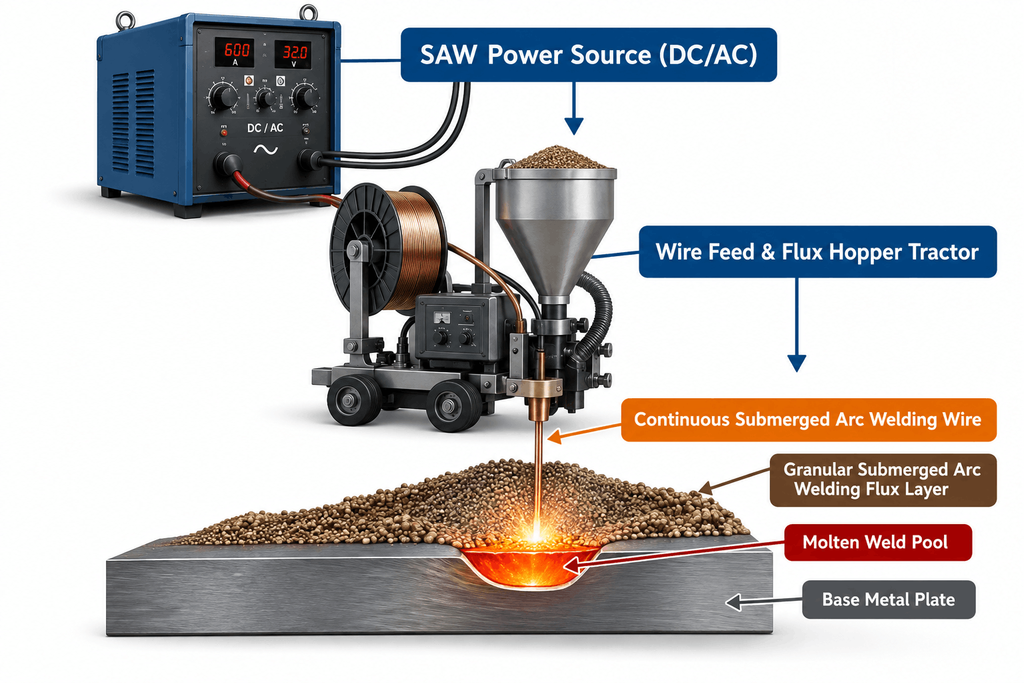
Because the process shields the arc completely, operators are protected from dangerous ultraviolet radiation and intense glare. This unique mechanical arrangement allows heavy fabrication shops to run high currents without creating excessive smoke or metal spatter.
How the Submerged Arc Welding Process Operates
Understanding the fundamentals of the submerged arc welding process helps engineers select the right machinery for specific steel grades and thickness profiles. The step-by-step sequence of operation includes:
- Joint Preparation & Positioning: Plates are bevelled, clamped, and aligned on specialized turning rolls or welding manipulators.
- Flux & Wire Delivery: The automated tractor deposits a continuous layer of submerged arc welding flux while a motorized mechanism initiates the welding wire feed.
- Arc Ignition & Shielding: The electric arc strikes beneath the powder blanket. A portion of the granular layer melts into protective conductive slag, while the un-melted portion remains reusable.
- Deep Penetration Weld Creation: As the tractor moves forward, the molten wire and parent metal fuse, leaving behind a smooth, clean bead beneath a layer of protective slag.
When implemented with precision engineering controls, the submerged arc welding process provides exceptional thermal efficiency and unmatched joint soundess.
Core Components of an Industrial Submerged Arc Welding System
To maximize return on investment, buyers must evaluate each subsystem of a submerged arc welding machine rather than evaluating the power source in isolation.
1. SAW Power Source
The power source supplies the electrical energy required to sustain heavy currents. Modern industrial setups utilize either thyristor-controlled transformers or advanced inverter-based power supplies. Inverter technology delivers precise current modulation, superior energy efficiency, and instant dynamic response compared to legacy units.
2. Welding Wire Feed Assembly
A steady, reliable welding wire feed mechanism prevents arc instability and uneven joint penetration. High-performance tractors feature heavy-duty four-roll drive systems that push or pull thick wires smoothly without slippage.
3. Integrated Flux Recovery Unit
Wasting unused granular flux increases consumable costs over time. A built-in flux recovery unit uses vacuum suction to draw un-melted granules back into the primary hopper, filtering out fine dust particles and slag remnants so the material can be recycled immediately.
4. Welding Carriage or Tractor Head
The automated carriage carries the wire spool, flux hopper, control panel, and torch head along the joint at a constant linear speed, guaranteeing seam uniformity.
Key Advantages of High-Deposition Welding Equipment
Upgrading to modern heavy fabrication equipment provides immediate operational and structural benefits:
- Unmatched Deposition Rates: SAW systems achieve true high-deposition welding, allowing fabricators to lay down up to 10–20 kg/hr (or even higher in multi-wire systems) compared to 2–4 kg/hr with manual arc methods.
- Deeper Joint Penetration: High amperage support ensures full penetration on thick steel plates, reducing the need for costly joint beveling and multi-pass operations.
- Operator Safety and Environment: Without visible arc flash, harsh glare, or heavy toxic fumes, workshop safety and air quality improve dramatically.
- Minimal Weld Defects: Uniform travel speeds and constant electrical parameters eliminate common human errors such as porosity, cold laps, and severe undercut.
Key Consumables: Submerged Arc Welding Wire & Flux
Even the most advanced submerged arc welding machine cannot deliver quality results without correctly matched consumables.
Selecting the Right Submerged Arc Welding Wire
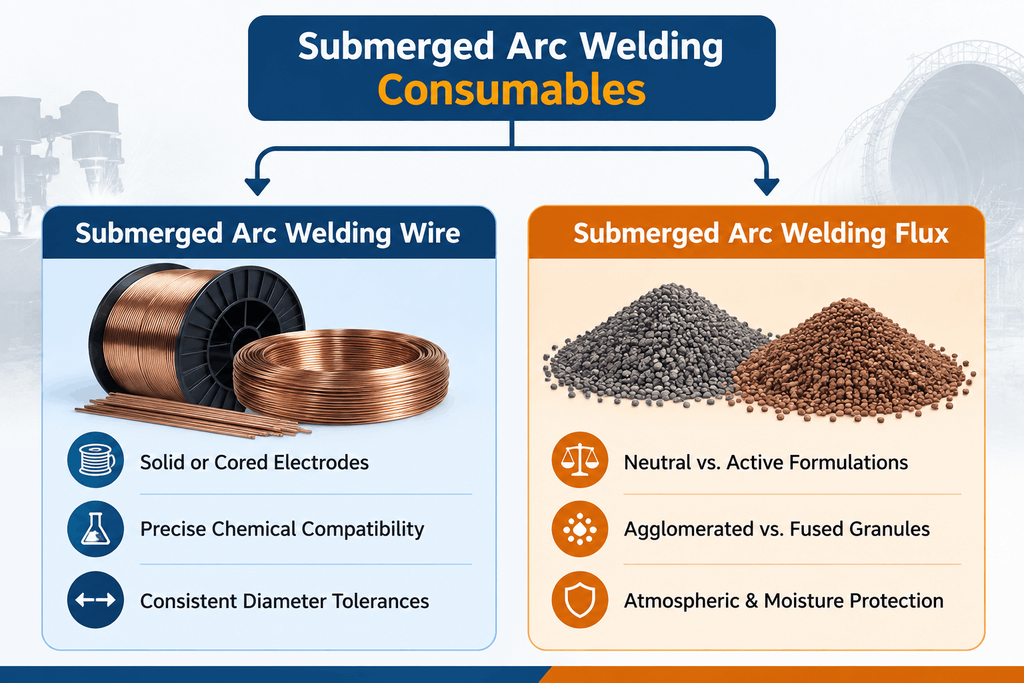
The submerged arc welding wire serves as the primary filler metal. Depending on structural strength and metallurgical specifications, engineers select solid carbon steel, low-alloy steel, or stainless steel wires. Consistent wire diameter tolerances and high-quality surface copper coatings prevent feeding jams inside torch liners.
Selecting the Ideal Submerged Arc Welding Flux
The submerged arc welding flux acts as more than a protective shield—it deoxidizes the weld pool, alloy elements can be added through it, and it shapes the finished bead contour.
- Fused Fluxes: Excellent for high travel speeds and resistant to moisture absorption.
- Agglomerated Fluxes: Offer superior alloy additions and better slag detachability in deep-groove joints.
Using well-dried, contaminant-free flux guarantees sound radiographic inspection scores in high-pressure applications.
Comparative Analysis: SAW vs. Other Automated Welding Processes
When purchasing heavy fabrication equipment, reviewing process efficiency matrix tables helps validate technology choices:
| Feature / Metric | Submerged Arc Welding (SAW) | MIG/MAG Welding (GMAW) | TIG Welding (GTAW) |
| Deposition Rate | Very High (up to 20+ kg/h) | Moderate (3 – 8 kg/h) | Low (1 – 3 kg/h) |
| Penetration Depth | Deep to Extreme | Medium | Shallow |
| Spatter Level | Zero Spatter | Low to Moderate | Zero |
| Arc Visibility | Hidden (Buriable under flux) | Fully Visible | Fully Visible |
| Plate Thickness Focus | Medium to Heavy (8mm – 100mm+) | Thin to Medium | Thin Sheet Metals |
| Automation Compatibility | Exceptional / Primary choice | High | High |
Technical Features to Evaluate Before Buying
To ensure your new automatic arc welding equipment delivers long-term productivity, carefully check the following technical parameters:
1. Duty Cycle & Current Capacities
For continuous structural manufacturing, choose a submerged arc welding machine offering a 100% duty cycle at maximum output (e.g., 1000A or 1250A). Running machines continuously without thermal overload shutdowns keeps production lines moving uninterrupted.
2. Integration with Special Purpose Machines (SPM)
If your plant manufactures LPG cylinders, wind towers, or heavy girders, verify if the power source and controller integrate easily into columns, booms, turning rolls, or custom gantries. Explore Kaiyuan Industrial Automation Solutions to learn how synchronized motion controls improve floor performance.
3. Advanced Process Adaptability
Modern fabrication shops require equipment capable of handling specialized joint geometry. For extra-thick wall plates, check out specialized setups like Narrow Gap Submerged Arc Welding Technology to dramatically reduce groove volume and wire consumption.
Industry Applications of Heavy Fabrication Equipment
Automated submerged arc welding machine installations power critical infrastructure and heavy manufacturing worldwide:
- Pressure Vessels & Boilers: Securing leak-proof circumferential and longitudinal seams capable of withstanding extreme pressure conditions.
- Shipbuilding & Marine Structures: Joining thick hull plates and stiffener sections efficiently across long straight runs.
- Wind Tower Fabrication: Executing repetitive deep-penetration welds on massive steel cylindrical sections quickly.
- Railway & Structural Girders: Constructing heavy steel bridge girders and crane beams with minimal angular distortion.
- Surface Overlay & Cladding: Combining special alloy wire with anti-corrosive fluxes using specialized Kaiyuan Strip Cladding Systems to extend equipment service life.
For authoritative background on global industrial welding standards and metallurgy guidelines, visit the American Welding Society and reference structural fabrication criteria at the American Institute of Steel Construction.
Step-by-Step Selection Checklist for Plant Managers
Before issuing a purchase order for a submerged arc welding machine, follow this quick practical checklist:
- Assess Plate Thickness: Determine whether single-wire, tandem-wire, or narrow-gap technology best suits your joint designs.
- Review Duty Cycle Demands: Confirm the power source delivers continuous 100% duty cycle rating at your required working current.
- Inspect Wire Drive Robustness: Ensure the motorized carriage features four-roll drives capable of pulling heavy wire reels reliably.
- Evaluate Flux Handling: Verify the inclusion of an automated flux recovery unit to save material expenses and maintain a clean shop floor.
- Confirm Local Technical Support: Partner with an established manufacturer that provides local spare parts, prompt engineering service, and operator training.
Upgrade Your Production Floor with Kaiyuan Engineering
Selecting high-efficiency automatic arc welding systems requires dependable manufacturing partners who understand complex industrial applications.
At Kaiyuan Welding & Cutting Automation India Pvt Ltd, based in Pune, Maharashtra, we combine over 30 years of global automation expertise with cutting-edge Japanese Panasonic technology. Our heavy-duty submerged arc welding power sources, automated carriages, specialized narrow-gap setups, and custom Special Purpose Machines (SPMs) help fabrication facilities double their output while keeping downtime low.
- Tailored Engineering: Customized fixtures designed for your exact job geometries.
- Uncompromising Quality: Robust power units built to operate reliably in high-heat environments.
- Comprehensive Service Support: Fast local availability of critical torch parts, drive rolls, and maintenance support.
Contact Kaiyuan Engineering Experts Today to discuss your fabrication challenges, schedule a technical consultation, or request a customized equipment quote!
Frequently Asked Questions (Q&A)
Q1: What makes a submerged arc welding machine suitable for thick plate joining?
A submerged arc welding machine can supply sustained high currents (often 600A to 1600A) at a 100% duty cycle. This high thermal output provides deep joint penetration, allowing heavy plates to be joined in far fewer passes compared to gas-shielded methods.
Q2: Can submerged arc welding be used in out-of-position welds (e.g., vertical or overhead)?
No, conventional SAW is restricted to flat and horizontal-fillet positions. Because the process relies on a granular submerged arc welding flux layer to blanket the arc, gravity would cause loose flux to fall off in vertical or overhead orientations.
Q3: Why is a flux recovery unit important in an automated setup?
A flux recovery unit vacuums up un-melted granules directly behind the torch head, filtering dust and returning clean flux to the hopper. This cuts consumable waste by up to 50% and helps keep the working area clean.
Q4: What is the main difference between single-wire and narrow-gap submerged arc welding?
Standard SAW uses traditional V- or U-groove joints that require substantial filler metal. Narrow-gap SAW uses specialized narrow joint geometry with near-parallel walls, cutting wire consumption and total heat input while dramatically speeding up cycle times on thick sections.