
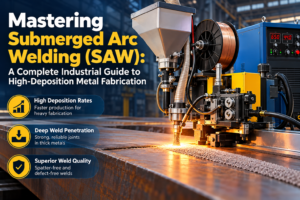
Mastering Submerged Arc Welding (SAW): A Complete Industrial Guide to High-Deposition Metal Fabrication
In modern heavy manufacturing, achieving high-speed production without sacrificing structural integrity requires advanced technology, making the deployment of an efficient submerged arc welding machine critical for heavy-gauge metal fabrication. Industries ranging from massive shipbuilding yards to large-scale pressure vessel manufacturing plants constantly look for ways to optimize throughput, ensure pristine weld quality, and lower operational overheads. Submerged Arc Welding (SAW) has emerged as the cornerstone process for meeting these rigorous demands. By blanketing the arc and molten pool beneath a layer of fusible granular flux, this method shields the weld zone entirely from environmental interferences while delivering unmatched deposition rates.
Understanding Submerged Arc Welding (SAW) and Its Core Principles
At its core, Submerged Arc Welding is an arc welding process where the arc is hidden beneath a blanket of granular, fusible flux. When the electrical circuit is energized, an arc is struck between a continuously fed wire electrode and the workpiece. Because the arc is completely buried beneath the flux, it remains invisible during operation, which eliminates the intense ultraviolet radiation and visible glare typical of manual metal arc or MIG welding.
The heat generated by the electric arc melts both the base metal, the filler wire, and a portion of the granular flux. The melted flux becomes a liquid slag that floats on top of the molten weld pool, protecting the metal from atmospheric contamination and severe oxidation. Meanwhile, the un-melted flux remains intact and can often be recycled through recovery systems, making the process highly economical for long continuous runs.
To achieve optimal results across varying structural thicknesses, manufacturers rely heavily on a robust SAW power source designed to deliver stable voltage and amperage parameters over extended periods.
Key Components of an Automatic SAW Welding System
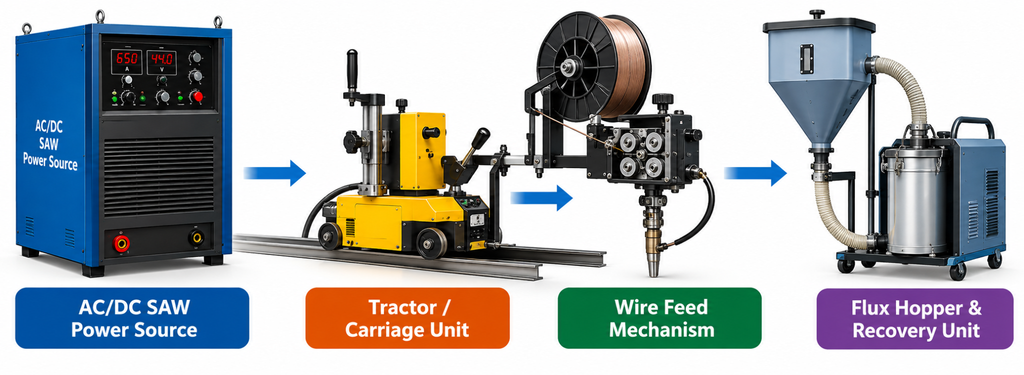
Deploying an automatic SAW welding system successfully requires a synchronized assembly of specialized mechanical and electrical hardware. Unlike manual or semi-automatic setups, an automated configuration minimizes human error and guarantees repeatable, flawless weld geometries.
1. The Power Source Infrastructure
Modern industrial fabrication demands flexibility, shifting between constant voltage (CV) and constant current (CC) setups. A specialized thyristor power source or an advanced inverter-based SAW machine ensures precise control over the heat input. This precise regulation is vital when working with metallurgically sensitive alloy steels.
2. The Welding Head and Tractor Carriage
Depending on the workpiece geometry, fabricators use either stationary welding heads mounted on columns and booms or a mobile tractor welding head. Tractor units are especially popular for long, straight butt and fillet welds found in plate panels and structural girders.
3. Continuous Wire Electrode and Flux Delivery Systems
The process relies on a continuous wire electrode fed seamlessly through a contact tube. Concurrently, a pressurized or gravity-fed flux hopper lays down an adequate blanket of granular material just ahead of the arc.
Technical Advantages Driving High-Deposition Metal Fabrication
Why do heavy industries prefer SAW over conventional GMAW or SMAW methods? The answer lies in its distinct metallurgical and operational benefits.
- Exceptional Deposition Rates: Because high currents can be safely applied to a continuous wire electrode, SAW yields deposition rates far superior to manual or standard semi-automatic alternatives.
- Deep Weld Penetration: The concentrated thermal profile drives deep into thick plates, dramatically reducing the number of joint passes required for heavy multi-pass joints.
- Superior Weld Pool Protection: The dense slag blanket completely shields the molten metal, virtually eliminating porosity and atmospheric defects.
- Spatter-Free Weld Integrity: Because the arc is fully submerged, metal spatter is non-existent, saving thousands of hours otherwise lost to post-weld grinding and cleanup.
For a deeper dive into how automated setups transform modern manufacturing floors, you can review the technical insights provided on the Kaiyuan Welding Automation Solutions platform. Additionally, understanding broader global fabrication standards can be explored via resources like the American Welding Society (AWS).
Critical Applications Across Heavy Industries
The versatility and sheer power of submerged arc welding make it indispensable across several heavy-duty manufacturing sectors:
1. Pressure Vessel and Boiler Manufacturing
Vessels operating under extreme internal pressures require absolute structural integrity. The use of specialized SAW configurations ensures crack-free, uniform seams across thick-walled carbon and alloy steels.
2. Shipbuilding and Marine Engineering
Shipyards utilize high-speed tractor systems to splice massive steel plates for hull construction, deck panels, and bulkheads, significantly reducing assembly timelines.
3. Structural Steel and Railway Girders
The fabrication of long-span bridges, heavy industrial columns, and railway infrastructure relies on deep penetration welds capable of withstanding cyclic fatigue over decades. For specialized insights on structural manufacturing, refer to resources like Welding Journal.
Optimizing Operational Parameters for Flawless Quality
Achieving perfection with a submerged arc welding machine requires careful calibration of several primary variables:
- Arc Voltage: Higher voltage widens the weld bead and decreases bead height, while lower voltage increases bead crown height.
- Welding Amperage: Controls the depth of penetration and the overall wire burn-off rate.
- Travel Speed: Affects heat input per unit length. Moving too slowly can cause excessive heat accumulation, while moving too fast leads to undercutting and lack of fusion.
- Flux Selection: Choosing between fused or agglomerated fluxes dictates the chemical and mechanical properties of the final weld metal.
Pitch: Elevate Your Fabrication Lines with Kaiyuan
In an era where precision, speed, and reliability dictate market leadership, partnering with the right automation provider can make all the difference. Kaiyuan Welding & Cutting Automation India Pvt. Ltd. (KWAI) stands at the forefront of industrial transformation, delivering state-of-the-art welding machinery engineered to match global benchmarks.
Whether you are scaling up production for heavy pressure vessels, structural girders, or specialized pipe manufacturing, Kaiyuan offers comprehensive solutions—ranging from advanced inverter-based power sources to fully integrated robotic and automated welding lines. Backed by decades of technical expertise, rigorous quality assurance, and robust after-sales support, Kaiyuan ensures your manufacturing plant achieves maximum throughput with minimal downtime.
Frequently Asked Questions (Q&A)
Q1: What is the primary benefit of using a submerged arc welding machine?
The primary benefit is the combination of extremely high deposition rates and deep weld penetration, which drastically reduces the number of passes required for thick metal plates. Furthermore, the granular flux blanket eliminates spatter and protects the weld pool from atmospheric contamination.
Q2: How does an inverter-based SAW machine differ from a traditional thyristor power source?
Inverter-based SAW machines utilize high-frequency switching technology, resulting in a smaller footprint, higher energy efficiency, and faster dynamic response times compared to heavier, traditional thyristor-controlled power sources.
Q3: Can submerged arc welding be used for all positions?
No. Due to the loose, granular nature of the flux blanket, SAW is traditionally restricted to flat and horizontal-fillet welding positions, as gravity is required to keep the flux in place over the weld zone.
Q4: Why is flux recovery important in automated SAW systems?
Since a large portion of the granular flux remains un-melted during the welding process, using an automatic flux recovery and recycling unit reduces material waste, lowers operational costs, and keeps the workspace clean.