
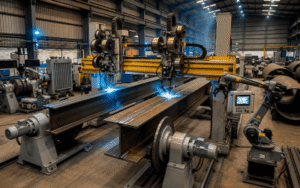
The Ultimate Guide to the Best Welding Automation Solutions for Steel Fabrication
The global steel fabrication sector is undergoing a massive paradigm shift. As structural demands grow more complex and labor shortages continue to squeeze shop floor capacities, traditional manual welding is rapidly becoming a bottleneck. To maintain a competitive edge, forward-thinking manufacturers are transitioning to automated workflows. Implementing the Best Welding Automation Solutions for Steel Fabrication is no longer just a luxury for high-volume automotive plants; it has become an absolute survival strategy for heavy engineering, infrastructure, pre-engineered buildings (PEBs), and shipbuilding industries.
Automation addresses the most critical vulnerabilities of manual fabrication: inconsistent bead profiles, slow cycle times, high rejection rates, and escalating labor costs. By integrating specialized mechanics, smart power sources, and precise torch manipulation, modern structural steel welding systems can run continuously while producing flawless, code-compliant welds.
Whether your facility focuses on massive infrastructure girders, heavy-duty pressure vessels, or high-volume conveyor rollers, understanding how to deploy automated setups is key to unlocking exponential productivity. Let’s delve into how advanced automation systems redefine modern industrial manufacturing.
Why Modern Heavy Industry Demands Automated Welding Systems
The structural integrity of a bridge girder, an offshore platform, or a high-pressure vessel depends entirely on the quality of its joints. Relying purely on manual stick or semi-automatic MIG welding introduces a variable that modern QA/QC standards cannot tolerate: human fatigue.
When multi-pass welds are executed manually, operators face extreme heat, toxic fumes, and strenuous working positions. Over an eight-hour shift, this inevitably leads to slight fluctuations in travel speed and torch angle, manifesting as porosity, slag inclusion, or lack of fusion. In heavy manufacturing, repairing a single rejected volumetric weld can cost thousands of dollars in gouging, re-welding, and non-destructive testing (NDT) delays.
By adopting customized industrial welding automation technology, companies drastically compress their cycle times while maintaining a perfect aesthetic and metallurgical profile. Automation guarantees that parameters like wire feed speed, voltage, and travel velocity remain perfectly synchronized from start to finish. This leads to an optimized production ecosystem where material waste is eliminated, gas usage is controlled, and turnaround timelines become highly predictable. Learn more about the rigorous requirements of industrial design via the American Institute of Steel Construction (AISC), which sets the benchmark for structural steel safety and compliance.
Core Technologies Defining the Best Welding Automation Solutions for Steel Fabrication
Achieving the absolute highest standards in structural fabrication requires a tailored approach. No single machine fits every unique shop layout or product mix. Instead, top-tier manufacturers rely on a strategic suite of automated machinery built to tackle specific geometric challenges.
1. High-Efficiency Submerged Arc Welding (SAW) Systems
For thick plate joining, heavy beam fabrication, and deep penetration requirements, Submerged Arc Welding remains the undisputed king. By burying the arc beneath a blanket of granular, fusible flux, SAW eliminates radiation, sparks, and smoke, while offering unmatched deposition rates.
Kaiyuan has revolutionized this space by combining proprietary hardware with world-class engineering, building systems powered by specialized thyristor-based power sources. This advanced integration ensures an exceptionally stable arc, perfect arc striking, and consistent heat input even during deep-groove longitudinal or circumferential joints.
When applied to heavy structural columns or massive crane girders, an automated SAW tractor or column-and-boom system can seamlessly deposit massive amounts of filler metal with virtually zero risk of surface porosity. The result is a smooth, ripple-free weld profile that easily passes stringent ultrasonic and radiographic testing.
2. Deep-Penetration DP-TIG and Narrow Gap Solutions
When working with specialized alloys, high-strength steels, or heavy-walled pipe configurations, traditional wide-groove welding becomes incredibly inefficient. It requires massive volumes of filler wire and multiple passes, which introduces immense heat into the base metal, leading to severe thermal distortion.
To counter this, advanced facilities implement narrow gap welding techniques. Narrow gap configurations reduce the groove angle significantly, often down to just a few degrees. Welding within such a tight space requires extreme precision to ensure side-wall fusion without trapping slag.
By leveraging DP-TIG (Deep Penetration TIG) technology, fabricators can achieve deep joint penetration at significantly higher speeds than standard TIG setups. This combination minimizes the overall weld volume, slashes consumable costs, and reduces the total heat-affected zone (HAZ), preserving the mechanical properties of high-grade structural steels.
3. Comprehensive Cladding and Surface Overlay Equipment
Structural steel components operating in aggressive industrial environments—such as marine environments, chemical processing plants, or mining sectors—frequently require surface protection against corrosion and abrasive wear. Rather than fabricating entire components out of expensive exotic alloys, engineering teams use cladding systems to apply a high-performance protective alloy layer over standard carbon steel bases.
Modern cladding machinery relies on highly automated torch positioning to apply uniform overlays. Specialized strip cladding devices allow for wide, efficient single-pass layer deposition on flat tube sheets or inside heavy pressure vessels.
For complex geometries, specialized systems like 90-deg elbow cladding machines and small-diameter pipe inner cladding systems ensure consistent metallurgical bonding around tight radiuses. This precise control prevents dilution between the backing steel and the overlay alloy, extending the operational life of heavy industrial assets.
Optimizing Production Material Flows with Dedicated Production Lines
While standalone automated welding units provide a huge boost to efficiency, true optimization happens when material handling and welding are unified into an end-to-end automated pipeline. Moving heavy, awkward steel parts manually between separate workstations introduces major downtime, safety hazards, and logjams.
Traditional Flow:
Cutting Floor -> Manual Transport -> Manual Fit-Up -> Crane Rotation -> Manual Weld -> QA
Automated Flow:
Raw Material -> Integrated Cutting/Beling -> Automatic Fit-Up -> Automated Robotic Weld -> Continuous Outfeed
To maximize shop floor ROI, leading fabricators integrate dedicated heavy duty automated welding lines designed for specific industrial components. For instance, the production of material handling conveyor systems requires thousands of idler rollers. A fragmented process can quickly cripple a factory’s output. By using a fully integrated line—incorporating automatic pipe cutting, double-ended boring, automatic bearing housing assembly, and specialized housing welding units—a raw steel tube is transformed into a finished, heavy-duty conveyor component with minimal human intervention.
Similarly, sectors manufacturing heavy transportation assets or infrastructure components benefit immensely from specialized axle production lines and custom transformer radiator manufacturing lines. By transforming discrete, labor-intensive assembly processes into continuous, machine-governed workflows, manufacturers achieve high-volume throughput, eliminate crane dependency, and maximize their overall floor space utilization. For deep insights into the global industrial transformation standards, explore the latest manufacturing technology updates from the International Federation of Robotics (IFR).
Essential Components of High-Performance Structural Steel Welder Setups
To maximize the returns on an investment in automation, it helps to understand the foundational components that work together behind the scenes. A premium automated welding setup is a finely tuned ecosystem comprising several critical sub-systems:
- Advanced Power Sources: The heart of any automated system. Whether utilizing high-current thyristor-based power sources for Submerged Arc Welding or inverter systems for high-speed MIG/MAG, the power source must deliver instantaneous arc feedback and absolute current stability to prevent defects during high-travel speeds.
- Precision Mechanical Manipulators: These include columns and booms, heavy-duty welding rotators, and multi-axis positioners. They ensure that the torch or the workpiece moves smoothly along the exact weld path without vibration or backlash.
- Intelligent Controller Interfaces: Modern PLC and NC controllers allow operators to store multi-pass welding programs, modify travel speeds on the fly, and closely monitor voltage and current parameters through intuitive HMIs.
- Seamless Seam Tracking & Vision Systems: In large-scale steel fabrication, pre-weld fit-up tolerances can vary. Laser-guided or tactile seam tracking systems dynamically adjust the torch position in real time, compensating for any joint deviations or plate warping.
Overcoming Critical Challenges in Structural Steel Welding
Shifting to high-level automation requires careful planning. Heavy steel fabricators face specific operational challenges that must be addressed during the design phase to unlock the true potential of their automated equipment.
Managing Thermal Distortion
Thick steel plates absorb vast amounts of thermal energy during welding. As the metal cools, uneven contraction can cause bowing, twisting, or angular distortion, throwing the entire structure out of structural tolerance.
The Best Welding Automation Solutions for Steel Fabrication combat this by optimizing heat input. Because automated systems maintain a precise, elevated travel speed, the total heat input per unit length is significantly lower than manual processes. Furthermore, utilizing advanced multi-axis fixtures and heavy-duty positioners allows shops to implement strategic dual-sided welding or rigid clamping sequences, keeping components perfectly square.
Mitigating Pre-Weld Fit-Up Variations
Manual welders can easily adapt to changing joint gaps by weaving the torch or slowing down their travel speed. Standard, non-adaptive automation machinery cannot do this; if a joint gap widens unexpectedly, it will result in burn-through or insufficient throat thickness.
To overcome this hurdle, modern manufacturing plants utilize high-precision preparation machinery alongside their welding lines. For example, deploying a 7-axis NC pipe cutting machine ensures that complex intersection cuts and weld bevels on structural pipes are executed with flawless geometrical accuracy. When the fit-up is mathematically perfect from the start, the automated welding system can operate at peak velocity without interruption, ensuring perfect penetration along the entire seam.
Future Trends: The Next Generation of Industrial Welding Automation Technology
The future of steel fabrication lies in total connectivity and adaptive intelligence. As the manufacturing sector embraces Industry 4.0, welding automation is evolving from pre-programmed path execution into smart, data-driven decision-making.
Next-generation systems are increasingly incorporating cloud connectivity and advanced data logging. Every single parameter—from wire feed consistency to gas flow rates—is recorded for every millimeter of the weld seam. This creates a digital birth certificate for structural components, simplifying QA documentation and allowing engineering teams to conduct predictive maintenance on the machinery before an unexpected breakdown occurs.
Additionally, off-line programming software is becoming highly streamlined. Fabricators can now import massive structural BIM or CAD models directly into the welding software, generating optimal torch paths, torch angles, and multi-pass weld sequences automatically. This slashes setup times for small-batch or highly customized structural fabrications, making automation highly profitable even for non-repetitive jobs.
Partnering with Kaiyuan: Your Gateway to World-Class Welding Excellence
Successfully integrating automation onto your shop floor requires more than just buying machinery off the shelf; it demands an experienced engineering partner who deeply understands the nuances of metallurgy, kinematics, and workflow design.
Kaiyuan Welding & Cutting Automation India Pvt Ltd (KWAI) stands at the very forefront of this industrial revolution. Established in 2015 in Pune, Maharashtra, as a 100% subsidiary of the globally renowned Kaiyuan Group, KWAI blends cutting-edge global technology with dedicated local engineering expertise. Built on a powerful foundation of specialized in-house innovations and strategic technology partnerships with industrial titans like Panasonic, Kaiyuan systems deliver unmatched reliability, ruggedness, and world-class performance.
Kaiyuan India Edge
– 100% Indian Subsidiary with Deep Global Backing
– State-of-the-Art Demo Center in Pune for Live Application Testing
– Proven Systems Deployed Across PEB, Infrastructure, & Pressure Vessel Sectors
– Seamless Integration of Heavy Material Handling & Advanced Power Sources
At our state-of-the-art demonstration and training center in Pune, clients can witness firsthand the extraordinary precision of our automated systems. From narrow-gap SAW installations to intricate saddle cutters and high-capacity cladding lines, we don’t just supply machinery we engineer complete production solutions tailored to your exact operational challenges. Our dedicated pre-sales, assembly, and post-sales support teams ensure that your transition to automated manufacturing is seamless, highly profitable, and configured for maximum long-term reliability.
Structural Production with Custom Automated Solutions
Are manual bottlenecks, rising labor shortages, or costly weld rejections holding back your facility’s growth? It’s time to transform your production floor into a high-efficiency powerhouse. Partner with the industry experts to deploy the Best Welding Automation Solutions for Steel Fabrication tailored precisely to your production goals.
Whether you want to integrate a standalone high-efficiency Submerged Arc Welding system, upgrade your vessel manufacturing with specialized cladding devices, or install a fully automated conveyor roller assembly line, Kaiyuan has the engineering expertise to turn your vision into reality.
Don’t let legacy production methods cap your output. Contact our engineering team today to schedule a comprehensive application consultation or a live machinery demonstration at our Pune facility. Let’s build a faster, safer, and infinitely more profitable manufacturing future together.
- Email Us: info@kaiyuan.in
- Call Our Experts: +91 77559 00921
- Visit Our Solutions Hub: Kaiyuan India Products
Frequently Asked Questions (Q&A)
Q1: What makes Submerged Arc Welding (SAW) ideal for structural steel fabrication?
SAW is highly favored for heavy steel fabrication because it offers exceptionally high deposition rates and deep joint penetration. Because the welding arc is completely submerged under a protective blanket of granular flux, it eliminates sparks, intense light radiation, and smoke. This creates a significantly safer environment for operators while consistently producing high-quality, dense welds that effortlessly pass non-destructive testing (NDT).
Q2: How does narrow gap welding save on consumable costs?
Traditional thick-plate welding requires a wide V-groove joint preparation, which demands multiple passes and a substantial amount of filler wire to fill the gap. Narrow gap welding minimizes the joint bevel angle to just a few degrees. This drastically reduces the total cross-sectional area of the joint, requiring far less filler wire and shielding gas, while significantly cutting down total cycle times and thermal distortion.
Q3: Can automated welding systems handle small-batch or customized steel production?
Absolutely. While automation delivers massive returns on high-volume, repetitive components (like conveyor rollers), modern NC controllers, adaptive seam tracking, and flexible positioners make it fast and easy to switch between designs. This allows modern fabricators to profitably automate small-batch runs of varied structural columns, beams, or pipe manifolds with minimal downtime.
Q4: Why is edge preparation so important for automated welding lines?
Automated welding systems follow a precise mathematical path at constant speeds. If the gap or bevel angle varies wildly due to poor manual cutting, the system may suffer from insufficient fusion or burn-through. Utilizing precision cutting machinery, such as a 7-axis NC pipe cutting machine, guarantees uniform fit-ups across your production runs, allowing the automated torch to perform flawlessly without constant human manual intervention.
Q5: What support infrastructure does Kaiyuan offer for fabricators in India?
Operating from a comprehensive headquarters in Pune, Maharashtra, Kaiyuan Welding & Cutting Automation India (KWAI) provides complete lifecycle support. This includes specialized pre-sales engineering consulting, custom machinery assembly, comprehensive operator training programs, and a responsive post-sales service team. Our fully equipped Pune demonstration center allows customers to test their specific structural welding applications on live machinery before finalizing their equipment layouts.