
Spot vs. Projection Welding: Choosing the Best Single Phase AC Spot Welder for Sheet Metal & Automotive Assembly
In modern metal fabrication, selecting the correct resistance welding methodology directly impacts structural integrity, production cycle speed, and operating costs. Manufacturing engineers routinely face a critical decision: should you utilize traditional spot welding or opt for projection welding? Choosing the right single phase AC spot welder or dual-capability machine can mean the difference between seamless high-volume production and costly re-work.
Both processes rely on electrical resistance heat generated by passing a high current through metal workpieces clamped under high pressure. However, the mechanical delivery, current density, and part geometry requirements differ significantly between the two techniques. This comprehensive guide evaluates the core differences between spot and projection welding, explores their ideal industrial applications in sheet metal spot welding, and helps you select the right industrial AC resistance welder for your assembly line.
Understanding Resistance Welding Principles: Spot vs. Projection Welding
To determine which process fits your production line, it is essential to understand how resistance welding equipment transforms electrical power into permanent metallic bonds.
What is Spot Welding?
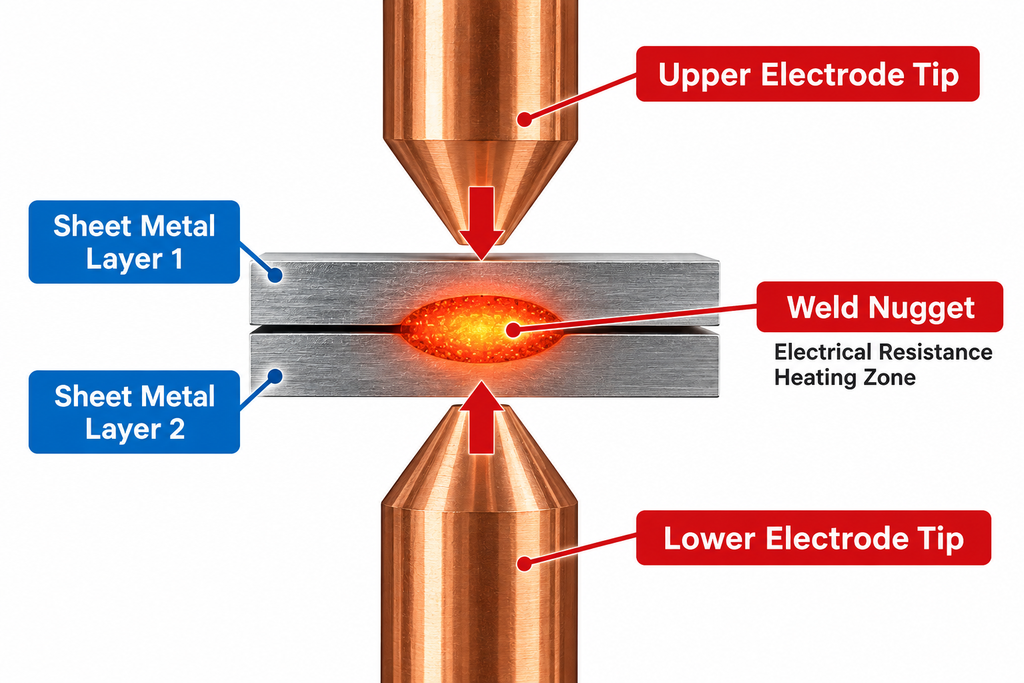
Spot welding is a resistance welding technique where opposed copper alloy electrodes clamp two or more overlapping metal sheets together. As a high welding current flows from one electrode to the other, electrical resistance at the sheet interface generates localized heat. This melts the base metals and forms a localized weld nugget upon cooling.
The spot diameter and joint strength depend directly on the size and geometry of the electrode tips. While simple and highly versatile, spot welding requires dedicated surface contact for every individual weld nugget created.
What is Projection Welding?
Projection welding is a specialized variant of resistance welding where the weld locations are determined by small embossed projections, dimples, studs, or fasteners on one or both of the workpieces. Instead of relying on pointed electrode tips, flat copper platens apply uniform electrode pressure across the joint area.
When the single phase AC spot welder fires, the current concentrates through the small projections. The immense localized resistance causes the projections to collapse under force, forging multiple strong weld joints simultaneously in a single machine stroke.
Head-to-Head Comparison: Spot Welding vs. Projection Welding
To help you choose the best machine configuration for your plant floor, let us examine the fundamental operational differences between these two methodologies:
| Feature / Metric | Spot Welding | Projection Welding |
| Current Concentration | Directed by electrode tip diameter | Directed by pre-formed projections or embossed dimples |
| Electrode Type | Pointed or contoured copper alloy tips | Flat, broad copper platens or custom tooling |
| Electrode Wear | High; tips require frequent dressing/reshaping | Low; flat platens distribute heat and force over a large area |
| Welds Per Stroke | Single weld nugget per cycle | Multiple weld nuggets simultaneously per cycle |
| Thickness Limits | Ideal for thin to medium sheet metal gauges | Excellent for thick plates, studs, nuts, and heavy brackets |
| Surface Finish | May leave tip indentation marks on outer metal sheets | Leaves minimal outer mark when projection collapses cleanly |
| Tooling & Setup | Low setup costs; simple tip alignment | Higher initial setup costs due to custom dies and fixtures |
Why Machine Architecture Matters: Features of an Industrial Single Phase AC Spot Welder
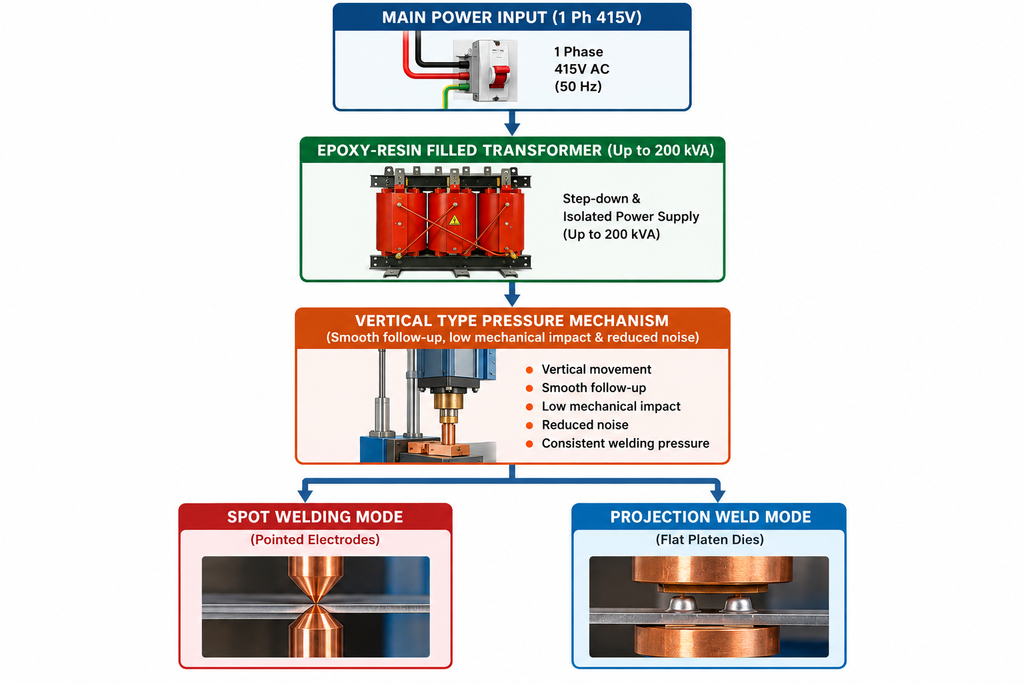
Whether you perform spot welding, projection welding, or a combination of both, the underlying transformer and frame architecture govern your welding performance. A premium single phase AC spot welder integrates key engineering enhancements to deliver repetitive weld quality across multi-shift industrial manufacturing.
1. Epoxy-Resin Filled Transformer
The heart of any industrial AC resistance welder is its transformer. Premium machines utilize an epoxy-resin filled transformer, which encapsulates primary and secondary windings within high-grade dielectric resin. This rugged construction protects internal components from moisture, metal dust, and thermal stress while delivering stable short-circuit currents up to 50,000 Amperes.
2. Vertical Type Pressure Mechanism
Precision mechanical force is just as critical as electrical current. Advanced spot and projection welding machine units employ a vertical type pressure mechanism. Unlike basic rocker-arm machines, vertical force application ensures parallel electrode contact without tip skidding. This delivers:
- Enhanced follow-up speed as the weld metal softens
- Reduced pneumatic air consumption
- Lower operational mechanical noise
- Extended electrode and fixture lifespan
3. Electrical Insulation & Short Circuit Prevention
In high-throughput shop floors, stray currents and accidental grounding cause weld defects and equipment downtime. Top-tier machines feature top-side electrical insulation. This prevents short circuit prevention failures when mounting heavy automated jigs, pneumatic clamps, or custom secondary tooling.
Deep Dive: Sheet Metal Spot Welding Applications
For standard sheet metal fabrication—such as HVAC ducting, steel enclosures, storage cabinets, and panel assembly—sheet metal spot welding on a single phase AC spot welder remains the industry standard.
Advantages for Sheet Metal Fabrication
- Flexibility: Easily adjust throat depth and electrode spacing to accommodate varying flange dimensions.
- Cost Efficiency: Eliminates the need for expensive embossing dies on low-to-medium production runs.
- Speed: Rapid pneumatic throat movement enables operators to execute up to 80-100 spot welds per minute.
Best Practices for Spot Welding Sheet Metal
- Maintain Tip Geometry: Regularly dress copper tips to maintain uniform surface contact area and prevent current density drops.
- Optimize Water Cooling: Continuous water flow monitoring ensures lower operating temperatures, preserving tip hardness and weld consistency.
- Set Proper Squeeze Time: Allow sufficient pneumatic clamping pressure prior to current flow to eliminate air gaps between sheets.
Deep Dive: Automotive Component Assembly & Heavy Hardware
When joining structural automotive pressings, heavy gauge brackets, weld nuts, or threaded studs, projection welding outpaces standard spot welding.
Advantages for Automotive Component Assembly
- Automotive Component Assembly Efficiency: Join multiple mounting tabs or weld nuts to chassis panels in a single machine stroke.
- Superior Weld Strength: Multiple discrete projection nuggets create redundant, fatigue-resistant structural bonds.
- Hardware Manufacturing Versatility: Weld threaded studs, fasteners, boss plates, and wire harnesses without damaging internal threads.
Projection Types Used in Industrial Manufacturing
- Embossed Dimple Projections: Cold-stamped into sheet metal panels for multi-spot joining.
- Solid Projections: Machined directly onto heavy forgings, cast bosses, or steel blocks.
- Ring / Annular Projections: Ideal for pressure-tight sealing on pipe bosses and hydraulic fittings.
Technical Performance & Specification Matrix
To evaluate equipment capabilities for your factory, consider the operational parameters of industrial combination spot/projection welders:
| Model Specification | Light-Duty (35-50 kVA) | Medium-Duty (70-100 kVA) | Heavy-Duty (160-200 kVA) |
| Rated Input Power | 1 Phase, 415V, 50Hz | 1 Phase, 415V, 50Hz | 1 Phase, 415V, 50Hz |
| Max Short Circuit Current | 13,000 – 19,500 A | 19,500 – 33,000 A | 36,000 – 50,000 A |
| Max Welding Force | 500 – 1,000 kgf | 1,000 kgf | 1,000 – 1,800 kgf |
| Electrode Travel Range | 20 / 60 mm | 20 / 80 mm | 20 / 80 mm |
| Primary Applications | Enclosures, light sheet metal, small brackets | Automotive stampings, weld nuts, medium plates | Heavy chassis parts, multi-projection joints, thick plates |
How to Choose the Right Resistance Welding Equipment
Selecting between spot welding, projection welding, or a combination machine depends on four critical manufacturing parameters:
1. Part Geometry & Pre-Forming Capabilities
If your stamped parts already include pre-formed projections or require welded fasteners (nuts/bolts), choose a projection welder or combination machine. If you weld flat or flanged sheet metal without prep work, standard spot welding is more economical.
2. Production Volume & Cycle Speed
For mass-production environments demanding high cycle speed, projection welding allows operators to make 3 to 6 welds simultaneously in one stroke, cutting production cycle times by up to 70%.
3. Material Type and Thickness
- Thin Sheets (<2.0 mm): Spot welding on a single phase AC spot welder delivers excellent results with fast setup.
- Thick Plates (>3.0 mm) or Dissimilar Gauges: Projection welding ensures heat concentration at the projection tip, preventing heat sink dissipation into the thicker plate.
4. Tooling Flexibility & Capital Investment
Dual-function machines—such as Kaiyuan’s DTN series single phase AC spot/projection welders—allow manufacturers to switch between spot welding tips and projection platens on the same frame, maximizing machine utilization.
Step-by-Step Optimization Guide for Peak Weld Quality
Achieving zero-defect resistance welds requires balancing electrical parameters with mechanical force.
Step 1: Optimize Electrode Force
Insufficient force leads to molten metal expulsion (sparking) and weak bond strength. Excessive pressure lowers electrical contact resistance, requiring higher current levels to reach melt temperature.
Step 2: Calibrate Current and Weld Time
Set your controller using a step-up current test:
- Start at low secondary current.
- Increment current until full nugget formation occurs without surface flash.
- Lock in optimal squeeze, weld, hold, and off-time parameters on the digital controller.
Step 3: Maintain Water Flow Cooling
Inadequate cooling damages transformers and causes copper tip degradation. Always verify cooling water flow using built-in sight displays or flow sensors.
To review official safety guidelines and industry standards for resistance welding equipment setup and operational safety, consult authority resources such as the American Welding Society (AWS) and the Resistance Welder Manufacturers’ Association (RWMA).
Strategic Advantage: Partnering with Kaiyuan Engineering
When upgrading your welding automation line, reliability and precision are paramount. Kaiyuan delivers heavy-duty, high-performance resistance welding machines built specifically for demanding industrial applications.
Key Benefits of Kaiyuan Resistance Welders:
- Rugged Heavy-Duty Frames: Designed to withstand continuous high-force operation without arm deflection.
- High Efficiency Transformers: Epoxy-resin encapsulated transformers ensure superior power efficiency and thermal stability.
- Integrated Safety Systems: Built-in insulation, short circuit protection, and continuous water-flow indicators safeguard operators and tooling.
- Custom Engineering: Tailored tooling, pneumatic controls, and SPM integration available for specialized assembly requirements.
Explore complete machine specs, download product catalogs, or request a technical quote on the Kaiyuan Single Phase AC Spot / Projection Welder Product Page.
Upgrade Your Assembly Line with Kaiyuan Resistance Welding Solutions
Are you ready to boost production throughput, reduce electrode wear, and achieve consistent, zero-defect weld quality across your sheet metal and automotive operations?
Kaiyuan offers a complete line of high-efficiency single phase AC spot and projection welders designed for long-term industrial reliability. Our team of welding engineers is ready to analyze your drawings, perform sample weld testing, and recommend the exact machine configuration for your plant.
Contact Kaiyuan Engineering Today to request a custom quote, arrange a live product demonstration, or discuss your automated welding needs with our technical team!
Frequently Asked Questions (FAQs)
What is a Single Phase AC Spot Welder?
A single phase AC spot welder is a resistance welding machine that utilizes single-phase alternating electrical current (typically 415V, 50Hz) and high electrode pressure to fuse overlapping metal sheets without filler metals. It generates localized resistance heat at the metal interface to create durable, repeatable weld nuggets.
What is the main operational difference between spot and projection welding?
Spot welding uses pointed or dome-shaped copper electrode tips to concentrate electrical current into a single weld point. Projection welding uses flat copper platens and concentrates current through pre-formed projections, dimples, or studs on the workpiece, allowing multiple welds to be formed simultaneously in a single stroke.
Can a single machine perform both spot and projection welding?
Yes! Combination machines, such as the Kaiyuan DTN series single phase AC spot/projection welder, feature quick-change electrode mounting arms. Operators can easily convert between spot welding tip holders and flat projection platens depending on job requirements.
What materials can be welded using a single phase AC spot welder?
Single phase AC spot welders excel at welding conductive ferrous alloys, including low carbon steel, mild steel, stainless steel, galvanized sheet metal, and high-strength automotive steel alloys.
How does a vertical type pressure mechanism improve weld quality?
A vertical type pressure mechanism applies straight, parallel downward clamping force without tip rotation or skidding. This delivers fast dynamic electrode follow-up as the weld material softens, ensuring minimal internal void formation, reduced sparking, lower air consumption, and superior overall weld consistency.