
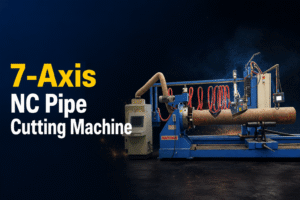
In modern heavy fabrication, precision engineering, and industrial piping, execution speed and joint accuracy determine your operational margin. Yet, many fabrication yards continue to rely on manual plasma torches, angle grinders, and hand-traced saddle templates. While manual cutting carries low initial capital expenditure, it introduces escalating costs through scrap material, fit-up delays, high skilled-labor dependencies, and extensive post-weld grinding.
Transitioning to an advanced 7-Axis NC Pipe Cutting Machine: Cost, ROI & When to Upgrade from Manual Cutting represents a pivotal upgrade for growing operations. Modern 7-axis numerical control (NC) profiling systems eliminate manual layout bottlenecks by synchronizing complex spatial motion, automated beveling, and multi-profile thermal cutting into a continuous, single-pass operation.
This comprehensive guide evaluates the economics of pipe fabrication, detailing hardware costs, payback metrics, productivity benchmarks, and key operational signals that indicate it is time to move past manual cutting.
What is a 7-Axis NC Pipe Cutting Machine?
A 7-Axis NC Pipe Cutting Machine: Cost, ROI & When to Upgrade from Manual Cutting is a fully automated CNC thermal profiling system engineered to perform intricate 3D cuts, intersect beveling, and hole penetrations on cylindrical pipes.
Unlike entry-level 2-axis or 4-axis profile cutters that only handle basic straight cuts or simple saddles, a 7-axis machine orchestrates seven distinct degrees of motion simultaneously. This dynamic multi-axis freedom allows the cutting head (oxy-fuel, plasma, or laser) to change its spatial angle relative to the curved pipe surface continuously.
The 7 Axes of Motion Explained
- X-Axis (Longitudinal Carriage Movement): Moves the main cutting gantry linearly along the length of the pipe.
- Y-Axis (Pipe Rotation): Rotates the pipe smoothly on motorized chucks or driving rollers.
- Z-Axis (Vertical Torch Elevation): Adjusts torch height to maintain optimal arc distance or focal point over uneven pipe surfaces.
- A-Axis (Torch Tilt / Bevel Angle): Angles the torch forward and backward to cut dynamic weld prep bevels (V, K, or Y joints).
- B-Axis (Torch Rotation / Swing): Swings the cutting head laterally around the intersection axis to maintain torch alignment on contoured cuts.
- C-Axis (Torch Height Control Fine-Adjustment): Rapid-response height tuning to compensate for pipe out-of-roundness.
- W-Axis (Material Feed / Auxiliary Conveyor Axis): Manages automatic material feeding, loading, and unloading along the bed length.
Through integrated CAD/CAM software, the machine translates complex 3D pipe intersection models into precise continuous cuts, creating perfect saddle joints, miters, slots, and branch connections without requiring manual layout markings.
7-Axis NC Pipe Cutting vs. Manual Cutting: A Head-to-Head Comparison
Understanding the structural differences between manual thermal cutting and 7-axis NC profiling highlights why automated shops consistently outcompete manual operations.
| Operational Feature | Manual Cutting & Grinding | 7-Axis NC Pipe Cutting Machine |
| Cut Profile Precision | Low (±2.0 mm to ±5.0 mm variation) | High (±0.2 mm to ±0.5 mm repeatability) |
| Bevel Prep | Manual hand-grinding required | Automated variable beveling in single pass |
| Production Speed | Slow (requires template tracing & fitting) | Up to 8x to 10x faster cutting speeds |
| Fit-Up & Weld Prep Time | High labor hours spent correcting gaps | Instant fit-up ready for immediate root passes |
| Material Scrap Rate | High (human error in layout & cut lines) | Minimal (<1% scrap via software nesting) |
| Labor Dependency | Requires highly skilled master fitters | Operable by a trained CNC technician |
Understanding the Cost Breakdown of a 7-Axis NC Pipe Cutting Machine
Investing in automated cutting equipment requires a clear understanding of the initial capital outlay and long-term operational expenditures. The total cost is structured around three main tiers:
1. Initial Capital Expenditure (CAPEX)
- Base Machine Hardware: The primary structure, including precision linear guides, heavy-duty chucks/rotators, servo motors, and multi-axis torch heads.
- Thermal Power Source: Choice between high-definition plasma units (ideal for stainless steel and high-speed mild steel cutting) or heavy-duty oxy-fuel systems (preferred for thick-walled carbon steel pipes).
- Software & Controller Systems: Advanced 3D pipe nesting software, CAD/CAM integration modules, and industrial NC motion control interfaces.
- Auxiliary Material Handling: Automated loading racks, outfeed conveyors, and fume extraction/dust collection units.
2. Operational Expenditure (OPEX)
- Power & Utilities: Electrical consumption for CNC controls, drives, plasma power supplies, and fume extraction systems.
- Consumables: Plasma nozzles, electrodes, shields, or oxy-fuel cutting tips.
- Shielding & Cutting Gases: Oxygen, fuel gas (LPG/Acetylene), Nitrogen, or compressed air depending on the metal cutting process.
3. Setup and Integration Costs
- Installation, foundation engineering, calibration, and hands-on operator training.
While high-capacity automated machinery requires upfront capital, it dramatically lowers total cost per cut by eliminating post-process labor and material waste.
Calculating Return on Investment (ROI) and Payback Period
Evaluating a 7-Axis NC Pipe Cutting Machine: Cost, ROI & When to Upgrade from Manual Cutting requires looking beyond initial purchase price to long-term financial yield. ROI is primarily driven by three cost-saving vectors: labor reduction, increased daily throughput, and reduced material scrap.
When to Upgrade from Manual Cutting: Key Operational Signals
Continuing with manual cutting too long can restrict shop growth. Upgrading to a automated 7-axis NC system becomes essential when specific operational bottlenecks appear.
1. Fit-Up Delays at the Welding Station
If your certified welders spend significant time using angle grinders to fix inconsistent bevel angles or bridge wide gap tolerances, your cutting process is creating a bottleneck. Precision NC profile cuts line up accurately every time, allowing welders to focus entirely on laying clean root passes.
2. Rising Scrap Rates on Complex Intersections
Manual template tracing for saddle joints, offset branch lines, and multi-pipe intersections frequently leads to miscuts. When scrap rates start eroding project margins, switching to automated CAD-to-cut profiling eliminates human layout error.
3. Inability to Scale Production
Manual cutting creates a strict limit on throughput. If your shop is turning down large structural steel projects, pressure vessel contracts, or offshore pipeline jobs due to delivery timelines, a 7-axis NC machine provides the speed required to take on higher project volumes.
4. High Dependency on Scarce Skilled Labor
Finding experienced manual fitters who can hand-layout complex branch cuts is increasingly difficult. A 7-axis NC machine embeds that geometric expertise into software, enabling standard operators to produce consistent, high-precision cuts.
Technical Features to Look for in a 7-Axis NC Pipe Cutting Machine
When evaluating machines for your fabrication facility, ensure the equipment includes features built for demanding industrial environments:
- Advanced CAD/CAM Integration: Seamless importing of STEP, IGES, and Tekla files directly into the machine interface for automatic profile generation.
- Dynamic Surface Height Tracking: Real-time sensor systems that automatically adjust the Z-axis to compensate for pipe ovality or out-of-round variance.
- Robust Clamping and Rotation Drives: High-torque servo motors paired with self-centering chucks or heavy-duty drive rollers to prevent slippage on heavy pipes.
- Multi-Process Compatibility: Dual-head options that integrate plasma for fast thin-wall profile cutting and oxy-fuel for thick carbon steel beveling.
- Automated Material Handling Integration: Outfeed systems designed to work with automated conveyor lines for continuous processing.
Real-World Applications Across Industries
Automated multi-axis pipe profiling machinery provides significant production improvements across several major industries:
- Oil & Gas Pipeline Fabrication: Cuts high-precision saddle joints, branch connectors, and heavy-wall bevels built to withstand high operating pressures.
- Pre-Engineered Buildings (PEB) & Infrastructure: Speeds up production of tubular trusses, structural columns, and complex building intersections.
- Pressure Vessels & Process Equipment: Delivers accurate shell and pipe penetrations required for high-integrity vessel fabrication.
- Shipbuilding & Offshore Engineering: Solves complex profile cutting challenges for marine piping networks, deck structures, and jacket foundations.
- Conveyor & Idler Roller Manufacturing: Works smoothly alongside specialized production equipment, such as an Automatic Cutting and Turning Machine, to speed up continuous pipe end machining.
Elevate Your Fabrication Capabilities with Kaiyuan India
Upgrading your workshop from manual cutting to an automated CNC environment requires reliable machinery backed by practical engineering support.
At Kaiyuan Welding & Cutting Automation India Pvt. Ltd. (KWAI), we deliver advanced industrial automation designed for modern manufacturing requirements. Located in Pune, Maharashtra, our facility manufactures durable, high-precision equipment built for demanding heavy fabrication tasks.
Beyond multi-axis pipe profiling, Kaiyuan offers a comprehensive portfolio of integrated automation solutions:
- Take a look at our robust 7-Axis NC Pipe Cutting Machine engineered for high-precision profile cutting and complex beveling.
- Upgrade your heavy structural and joint preparation processes with our specialized 4-Axis NC Saddle Cutter.
- Explore broader automation options across our full line of industrial systems on the Kaiyuan Product Catalog.
Whether you need to upgrade an existing pipe workshop or set up a high-volume automated fabrication line, our engineering team provides complete solution design, system integration, operator training, and ongoing service support.
To learn more about industrial CNC thermal cutting standards and metal fabrication practices, explore resources from the American Welding Society (AWS) and technical guides from Welding Design & Fabrication.
Frequently Asked Questions (Q&A)
Q1: What is the main difference between a 4-axis and a 7-axis NC pipe cutting machine?
A 4-axis machine handles basic longitudinal motion, pipe rotation, torch height, and a single tilt angle for standard saddle cuts. A 7-axis machine adds dynamic multi-angle torch rotation, continuous variable beveling (V/K/Y joints), and coordinated material feeding. This allows it to handle complex 3D joint geometries, multi-pipe intersections, and variable weld prep bevels in a single automated pass.
Q2: Can a 7-axis NC pipe cutting machine handle both plasma and oxy-fuel torch heads?
Yes. Many industrial systems support dual-torch configurations. High-definition plasma is used for rapid, clean cuts on thin-to-medium wall carbon steel and stainless steel, while oxy-fuel is used for thick-walled carbon steel pipes.
Q3: How difficult is it for operators to transition from manual cutting to CNC machine software?
The transition is straightforward. Modern NC pipe cutters feature user-friendly CAD/CAM software interfaces. Operators can import 3D model files (such as STEP or Tekla) directly, and the software automatically generates the motion paths, cutting speeds, and torch angles required for processing.
Q4: How does a 7-axis pipe cutter reduce overall welding costs?
By producing highly accurate cuts (±0.2 mm to ±0.5 mm) with consistent, automated weld preparation bevels, the machine ensures clean joint fit-up. This minimizes wide gaps, reduces weld metal consumption, speeds up fit-up times, and eliminates hours of post-cut hand grinding.
Q5: What pipe diameter and wall thickness ranges can these machines accommodate?
Work envelopes vary by machine model. Standard industrial setups typically process pipe diameters ranging from 50 mm (2 inches) up to 1200 mm (48 inches) or more, handling wall thicknesses from thin-walled tubing up to heavy-wall pipes exceeding 50 mm, depending on whether plasma or oxy-fuel cutting is selected.